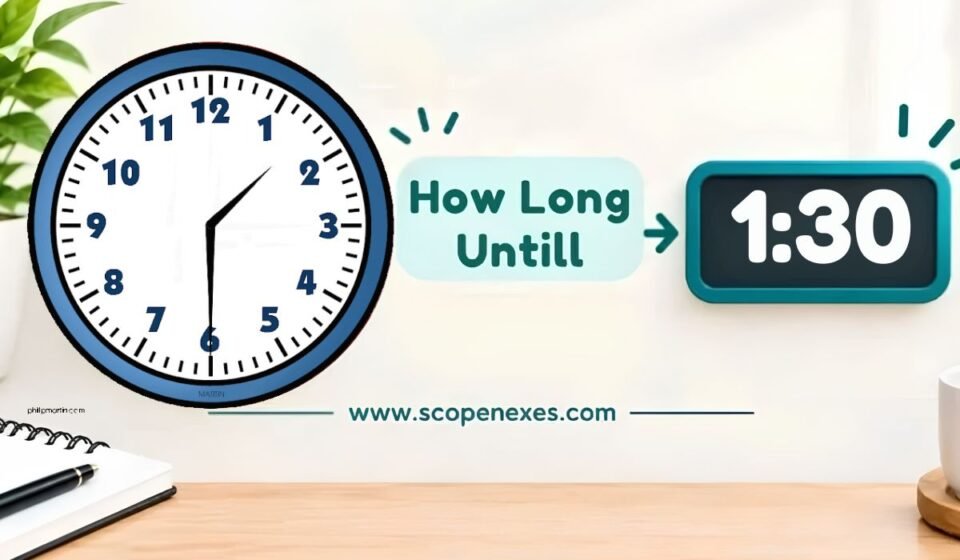

To answer How Long Until 1:30, subtract the current time from 1:30. At noon, you have 1 hour and 30 minutes remaining. At 1:00, you have 30 minutes left.
The catch is that there is no single fixed answer. The gap changes every minute and also depends on whether you mean 1:30 PM or 1:30 AM. This guide shows you how to find the right answer in seconds, with tables you can use to check your math.
How do you calculate how long until 1:30?
You count up to the next full hour, then add whatever remains. This works better than plain subtraction because you never have to borrow minutes from an hour.
Follow these steps:
- Read the current time.
- Count the minutes left until the next full hour.
- Count the full hours from that point up to 1:00.
- Add the final 30 minutes.
Say it’s 10:40 AM. Twenty minutes gets you to 11:00. Two more hours gets you to 1:00 PM. Add 30 minutes and you land on 2 hours and 50 minutes.
Try a second one. It’s 12:08 PM. Fifty two minutes gets you to 1:00. Add 30 and you have 1 hour and 22 minutes.
Do it once on paper. After a few rounds you’ll do it in your head.
What is the minutes from midnight method?
You turn both times into minutes after midnight, then subtract. It takes longer, but it handles any starting time without special rules.
1:30 PM is 13:30 on a 24 hour clock. That equals 810 minutes after midnight, because 13 times 60 is 780 and you add 30. Now take 10:40 AM, which is 640 minutes. The difference is 170 minutes, or 2 hours and 50 minutes.
Same answer as the first method. Pick whichever one feels natural.
Do you mean 1:30 AM or 1:30 PM?
Most people mean 1:30 PM, the afternoon one. But 1:30 AM is just as real, and it sits deep in the night. Decide which one you need before you count anything.
Here is how they differ:
- 1:30 AM is 01:30 on a 24 hour clock. It comes 90 minutes after midnight.
- 1:30 PM is 13:30. It comes 90 minutes after noon.
Noon is 12:00 PM. Midnight is 12:00 AM. Those two labels trip up a lot of people.
If someone says “1:30” with no label, they usually mean the next 1:30 that falls during waking hours. Don’t rely on that guess for anything important. Ask, or write the time as 13:30 or 01:30.
How long until 1:30 PM from common starting times?
The table below covers the most common starting points on the same day. Find your current time and read across.
| Current time | Time left until 1:30 PM |
| 6:00 AM | 7 hours 30 minutes |
| 7:00 AM | 6 hours 30 minutes |
| 8:00 AM | 5 hours 30 minutes |
| 9:00 AM | 4 hours 30 minutes |
| 10:00 AM | 3 hours 30 minutes |
| 11:00 AM | 2 hours 30 minutes |
| 12:00 PM (noon) | 1 hour 30 minutes |
| 12:30 PM | 1 hour |
| 1:00 PM | 30 minutes |
| 1:15 PM | 15 minutes |
| 1:25 PM | 5 minutes |
Notice the pattern. Each hour earlier adds exactly one hour to the wait. And any start time at half past the hour gives you a clean number of hours.
What about an odd start time like 9:47 AM? Thirteen minutes gets you to 10:00. Three hours gets you to 1:00 PM. Add 30 and you get 3 hours and 43 minutes.
How long until 1:30 AM from common starting times?
Count to midnight first, then add 1 hour and 30 minutes. The midnight step is what makes this one feel harder than it is.
| Current time | Time left until 1:30 AM |
| 12:00 PM (noon) | 13 hours 30 minutes |
| 3:00 PM | 10 hours 30 minutes |
| 6:00 PM | 7 hours 30 minutes |
| 8:00 PM | 5 hours 30 minutes |
| 10:00 PM | 3 hours 30 minutes |
| 11:00 PM | 2 hours 30 minutes |
| 11:30 PM | 2 hours |
| 12:00 AM (midnight) | 1 hour 30 minutes |
| 12:45 AM | 45 minutes |
| 1:15 AM | 15 minutes |
Try an odd one. It’s 9:20 PM. Two hours and 40 minutes gets you to midnight. Add the extra 1 hour and 30 minutes. Your total is 4 hours and 10 minutes.
What if 1:30 has already passed today?
Then you’re counting toward tomorrow’s 1:30. The easiest way is to take 24 hours and subtract how far past 1:30 you are.
Say it’s 2:00 PM. You’re 30 minutes past 1:30 PM. So tomorrow’s 1:30 PM is 23 hours and 30 minutes away.
Now say it’s 4:00 PM. You’re 2 hours and 30 minutes past. Subtract that from 24 hours and you get 21 hours and 30 minutes.
The same trick works for the night version. At 3:30 AM, you are 2 hours past 1:30 AM. The next one is 22 hours away.
How does the 24 hour clock make it easier?
It removes the AM and PM confusion completely. On this clock, 1:30 PM is 13:30 and 1:30 AM is 01:30. You can’t mix them up.
To convert a PM time, add 12 to the hour. Noon stays 12:00 and midnight becomes 00:00. Those are the only two exceptions.
| 12 hour time | 24 hour time |
| 12:00 AM | 00:00 |
| 1:30 AM | 01:30 |
| 9:00 AM | 09:00 |
| 12:00 PM | 12:00 |
| 1:30 PM | 13:30 |
| 6:00 PM | 18:00 |
| 11:30 PM | 23:30 |
Subtraction gets easier too. Say it’s 09:45 and you want 13:30. Borrow one hour from the 13, so 13:30 becomes 12:90. Now subtract. Twelve minus 9 is 3, and 90 minus 45 is 45. The answer is 3 hours and 45 minutes.
Military time drops the colon. So 1:30 PM is written 1330, and 1:30 AM is written 0130.
How can you do it faster in your head?
Anchor on the nearest half hour, then fix the small gap. Since 1:30 sits on a half hour, you can jump to any :30 time and count whole hours.
Here is a simple habit. Round your current time to the closest :30. Count the hours to 1:30. Then add or subtract the few minutes you rounded.
Take 8:52 AM. Round to 8:30 AM. That is 5 hours from 1:30 PM. But you are 22 minutes past 8:30, so subtract 22 minutes. You get 4 hours and 38 minutes.
Use this practice table to test yourself. Cover the right column and work each one out.
| Current time | Time left until 1:30 PM |
| 7:34 AM | 5 hours 56 minutes |
| 8:52 AM | 4 hours 38 minutes |
| 10:15 AM | 3 hours 15 minutes |
| 11:48 AM | 1 hour 42 minutes |
| 12:20 PM | 1 hour 10 minutes |
| 1:07 PM | 23 minutes |
If you miss one, check which step slipped. It’s usually the jump across the hour.
Read More: How Long Until 5:30? Calculate the Time Remaining Easily
How many minutes or seconds are left until 1:30?
Multiply hours by 60 for minutes. Multiply hours by 3,600 for seconds. Half an hour is 1,800 seconds.
| Time left | Minutes | Seconds |
| 30 minutes | 30 | 1,800 |
| 1 hour | 60 | 3,600 |
| 1 hour 30 minutes | 90 | 5,400 |
| 2 hours | 120 | 7,200 |
| 2 hours 30 minutes | 150 | 9,000 |
| 3 hours | 180 | 10,800 |
| 4 hours 30 minutes | 270 | 16,200 |
| 5 hours 30 minutes | 330 | 19,800 |
Watch out for one common slip. 1 hour and 30 minutes is 1.5 hours, not 1.30 hours. Mixing those up causes errors in timesheets and spreadsheets.
Seconds matter when you set a timer by hand or write code. If a program asks for seconds, use the table.
How do time zones change the answer?
Your local clock decides the gap, so you must convert 1:30 into your own time first. Only then do you subtract.
Follow these steps:
- Find the UTC offset of the place where the 1:30 applies.
- Find your own UTC offset.
- Add or subtract the difference, then count as usual.
The table shows what 1:30 PM in London equals in other cities. It uses standard time offsets, and London is on GMT in winter.
| Place | Standard offset from UTC | Local time when it is 1:30 PM in London |
| New York | 5 hours behind | 8:30 AM |
| Chicago | 6 hours behind | 7:30 AM |
| Denver | 7 hours behind | 6:30 AM |
| Los Angeles | 8 hours behind | 5:30 AM |
| London | Same as UTC | 1:30 PM |
| Paris | 1 hour ahead | 2:30 PM |
| Dubai | 4 hours ahead | 5:30 PM |
| Delhi | 5 hours 30 minutes ahead | 7:00 PM |
| Singapore | 8 hours ahead | 9:30 PM |
| Tokyo | 9 hours ahead | 10:30 PM |
| Sydney | 10 hours ahead | 11:30 PM |
Daylight saving shifts some of these by one hour for part of the year. Regions change their clocks on different dates. So the gap can be off by an hour for a few weeks each spring and autumn. Check the date before you trust the table.
Here is an example. A call starts at 1:30 PM London time in winter. You’re in New York, where that equals 8:30 AM. If it’s 7:45 AM for you, you have 45 minutes.
What is the fastest way to get the exact answer?
Set an alarm for 1:30. It does the math for you and it doesn’t make mistakes. For exact seconds, a countdown tool beats mental math.
Here are your options:
- Phone alarm. Pick AM or PM with care. Many alarm apps show the time left once you save it.
- Phone timer. Enter the duration from the tables above.
- Voice assistant. Many of them can answer “how long until 1:30 PM” out loud.
- Countdown web pages. Free ones let you pick a target time and show a live clock.
- Spreadsheet formula. This one returns the time left until the next 1:30 PM: =MOD(TIME(13,30,0)-MOD(NOW(),1),1). Format the cell as h:mm. For 1:30 AM, change the 13 to a 1.
Spreadsheets store time as a fraction of one day. The MOD part wraps a negative result around, so a time that already passed rolls over to tomorrow.
How should you plan around a 1:30 deadline?
Treat 1:30 as the moment you must already be done. Don’t treat it as the moment you start finishing. Real tasks have hand off costs, like saving files, finding a room, or parking the car.
A sensible buffer depends on the situation.
| Situation | Suggested buffer before 1:30 |
| Video call | 5 minutes to test audio and camera |
| Meeting in the same building | 10 minutes |
| Public transport | 10 to 15 minutes |
| Drive across town | 15 to 20 minutes, more in heavy traffic |
Set a second alarm for 1:15. That gives you a 15 minute warning, so the deadline never sneaks up on you.
Avoid starting anything new in that last quarter hour. One quick email often turns into ten minutes. Many people also feel sleepy in the early afternoon, often after lunch. If you can, save the hard thinking for earlier in the day.
When does a 1:30 countdown matter most?
It matters most when a fixed start time meets a task that keeps moving. A 1:30 meeting, class, or appointment is the usual case.
Lunch breaks are another. If your break ends at 1:30, the countdown tells you when to head back to your desk. Shift workers use it the same way, since a shift change at 1:30 leaves no room for a late start.
Students run into it too. A class at 1:30 means the walk between buildings eats into your free time. So count back from 1:30 instead of forward from now.
That last idea helps everywhere. Start at 1:30, subtract your travel time, then subtract your buffer. The result is your real leave time.
Say you have a 20 minute drive and want a 10 minute buffer. You should leave by 1:00. If it’s 11:35 AM, you have 1 hour and 25 minutes of working time left.
What mistakes do people make when counting to 1:30?
Many slips come from labels, not arithmetic. Here are the ones to watch:
- Mixing up 12:00 AM and 12:00 PM. The first is midnight. The second is noon.
- Forgetting to check AM or PM.
- Treating minutes as decimals. 1 hour and 30 minutes equals 1.5 hours.
- Ignoring time zones or daylight saving on a remote meeting.
- Misreading regional phrases. In British English, “half one” means 1:30. In German, “halb zwei” also means 1:30.
- Skipping the buffer and arriving at exactly 1:30 with no slack.
FAQ’s
How many hours until 1:30 PM?
Subtract the current time from 13:30. At 9:30 AM, the answer is 4 hours. The number changes all day.
How long is it from 12:00 PM to 1:30 PM?
It is 1 hour and 30 minutes. That equals 90 minutes, or 5,400 seconds.
Is 1:30 the same as half past one?
Yes. Half past one means 30 minutes after 1:00. That is 1:30.
What is 1:30 PM in military time?
It is 1330, spoken as thirteen thirty. The AM version is 0130.
How do I find how long until 1:30 tomorrow?
Add 24 hours to the target, then subtract the current time. Or count the time left today, then add the time from midnight to 1:30.
Wrapping Up
The fastest answer to how long until 1:30 is an alarm. Set one now for the time you need. Add a second alarm 15 minutes earlier as a warning.
Then practice once. Pick an odd time like 9:47 AM and work it out. If you land on 3 hours and 43 minutes, the method is yours.