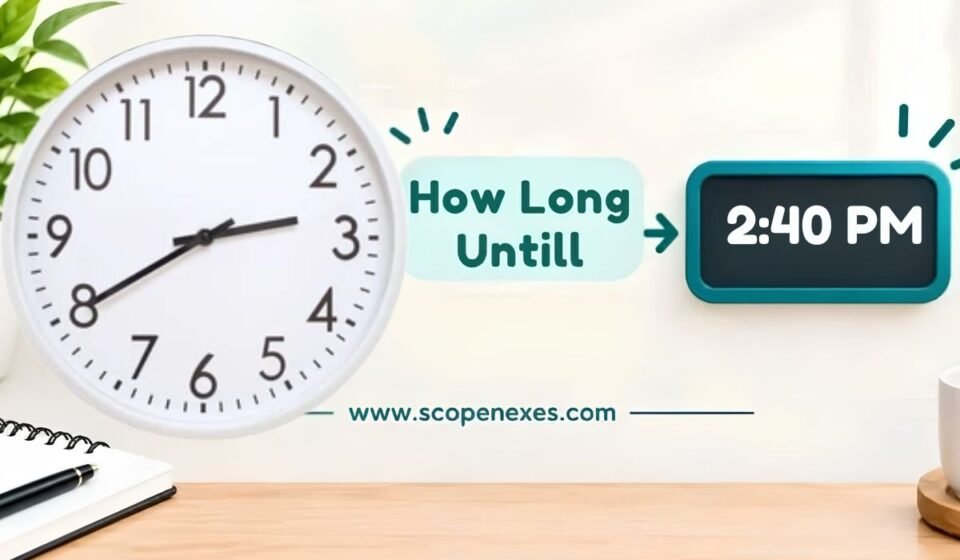

Wondering How Long Until 2:40 PM? Whether you’re waiting for a meeting, planning your afternoon, catching a ride, or simply keeping an eye on the clock, knowing the exact time remaining can be useful. The answer changes constantly as each minute passes, so there isn’t one fixed number that works all day.
In this guide, you’ll learn how to calculate the time until 2:40 PM, understand the difference between AM and PM, and quickly work out the remaining hours and minutes.
How do you calculate how long until 2:40 PM?
Subtract your current time from 2:40 PM, and borrow 60 minutes when the minutes don’t line up. After a few tries, it takes about ten seconds.
Here’s the full process.
- Write 2:40 PM as 2 hours and 40 minutes past noon.
- Write your current time the same way. For example, 1:15 PM is 1 hour and 15 minutes past noon.
- Subtract the minutes first. If your minutes are larger than 40, borrow one hour and add 60 minutes to the 40.
- Subtract the hours.
Try 1:15 PM. Minutes: 40 minus 15 leaves 25. Hours: 2 minus 1 leaves 1. You have 1 hour and 25 minutes.
Now try 1:50 PM. Here 50 is bigger than 40, so you borrow. Turn 2 hours 40 minutes into 1 hour 100 minutes. Then subtract 1 hour 50 minutes. You’re left with 50 minutes.
The count up method
Count up to the next round hour, then add the leftover minutes. It’s the fastest mental trick, and most people already do it without noticing.
From 1:50 PM, you need 10 minutes to reach 2:00 PM. Then you need 40 more to reach 2:40 PM. That’s 50 minutes in total.
From 12:25 PM, you need 35 minutes to reach 1:00 PM. Add 1 hour to reach 2:00 PM. Add 40 minutes more. The total is 2 hours and 15 minutes.
The minutes from midnight method
Convert both times into minutes after midnight, then subtract. This method is slower by hand. But it never fails, and it’s the one a spreadsheet or app uses.
The first step is knowing that 2:40 PM equals 880 minutes after midnight. You get that from 14 hours times 60, plus 40.
Say it’s 11:25 AM. That’s 11 times 60 plus 25, or 685 minutes. Subtract 685 from 880 and you get 195 minutes. Divide by 60 and you get 3 hours and 15 minutes.
How much time is left from common start times?
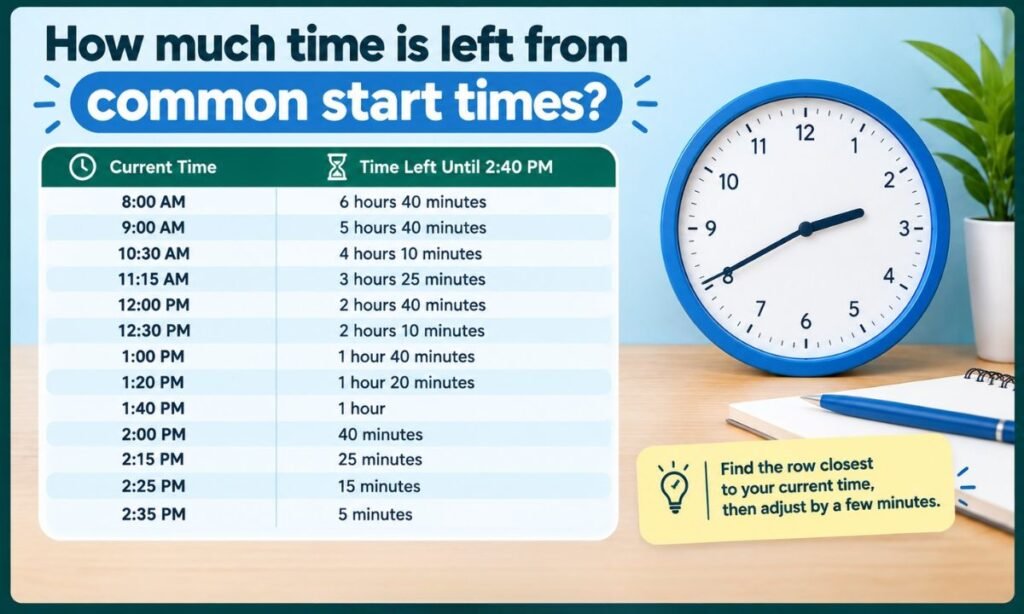
The table below shows the time left until 2:40 PM from popular start times. Find the row closest to your current time, then adjust by a few minutes.
| Current time | Time left until 2:40 PM |
| 8:00 AM | 6 hours 40 minutes |
| 9:00 AM | 5 hours 40 minutes |
| 10:30 AM | 4 hours 10 minutes |
| 11:15 AM | 3 hours 25 minutes |
| 12:00 PM | 2 hours 40 minutes |
| 12:30 PM | 2 hours 10 minutes |
| 1:00 PM | 1 hour 40 minutes |
| 1:20 PM | 1 hour 20 minutes |
| 1:40 PM | 1 hour |
| 2:00 PM | 40 minutes |
| 2:15 PM | 25 minutes |
| 2:25 PM | 15 minutes |
| 2:35 PM | 5 minutes |
Notice the pattern in the afternoon rows. From 1:20 PM, the wait is exactly 1 hour 20 minutes. The minutes mirror each other because 2:40 sits 20 minutes before 3:00.
That’s a handy shortcut. Think of 2:40 PM as “twenty to three” and count back from 3:00 PM.
What is 2:40 PM in 24 hour time?
2:40 PM is 14:40 on a 24 hour clock. In military style, people write it as 1440 and say “fourteen forty.” The rule is simple. For any PM hour from 1 to 11, add 12. So 2 plus 12 gives 14.
This matters when you read train tables, hospital schedules, or flight tickets. They often skip AM and PM entirely.
Here are a few related conversions for reference.
| 12 hour time | 24 hour time |
| 2:00 PM | 14:00 |
| 2:20 PM | 14:20 |
| 2:40 PM | 14:40 |
| 3:00 PM | 15:00 |
| 2:40 AM | 02:40 |
Another way to see it: 2:40 PM is 9,600 seconds past noon. That’s 160 minutes, each with 60 seconds. You’ll rarely need that number, but countdown apps often show it.
How do you read 2:40 PM on an analog clock?
The minute hand points at the 8, and the hour hand sits two thirds of the way from 2 to 3. Each number on the dial stands for 5 minutes. So 8 times 5 gives 40.
Many learners misread this one. The hour hand is close to the 3, so it looks like three o’clock. But it’s still the 2 o’clock hour until the minute hand returns to the 12.
You can also count the wait on the dial itself. Look at where the minute hand points now, then count the number steps to the 8. If it points at the 6, you have two steps to go. That’s 10 minutes. If the minute hand has already passed the 8, you’ve missed 2:40 for this hour. The next one is a full day away on the same dial.
Read More: How Long Until 2:20 AM? Calculate Time Remaining
How do you say 2:40 PM out loud?
Most people in the US say “two forty.” Many speakers in the UK say “twenty to three.” Both mean the same moment, and both are fine in daily talk.
Written invites need more care. “Two forty” doesn’t say AM or PM, so people can show up 12 hours apart. Write “2:40 PM” or “14:40” in any message that matters.
For a spoken reminder, adding a clue helps. Say “two forty this afternoon” and the confusion disappears.
What if it’s already past 2:40 PM?
If 2:40 PM has passed today, the next one is tomorrow. So you subtract the time since 2:40 PM from 24 hours.
Here’s the easy version. First, find how long ago 2:40 PM was. Then take that away from 24 hours.
- At 3:00 PM, 20 minutes have passed. You have 23 hours and 40 minutes left.
- At 6:00 PM, 3 hours and 20 minutes have passed. You have 20 hours and 40 minutes left.
- At 11:00 PM, 8 hours and 20 minutes have passed. You have 15 hours and 40 minutes left.
A common slip is forgetting midnight. After midnight, it’s a new calendar day, but the target is still the same 2:40 PM. So at 1:00 AM, you’re really looking at 13 hours and 40 minutes. Let’s check that. From 1:00 AM to noon is 11 hours. Add 2 hours 40 minutes. The total is 13 hours and 40 minutes.
How do you count down from a morning time?
Count to noon first, then add 2 hours and 40 minutes. Noon is a clean halfway point, and it keeps the math easy.
Take 9:20 AM. It’s 2 hours 40 minutes to noon. Add another 2 hours 40 minutes. The answer is 5 hours and 20 minutes. Take 7:45 AM. It’s 4 hours 15 minutes to noon. Add 2 hours 40 minutes. You get 6 hours and 55 minutes.
Here’s a small catch. Many people stumble when the minutes cross 60. If you reach 55 minutes plus 40 minutes, that’s 95 minutes. Turn it into 1 hour 35 minutes and carry the hour.
How do you find 2:40 PM in another time zone?
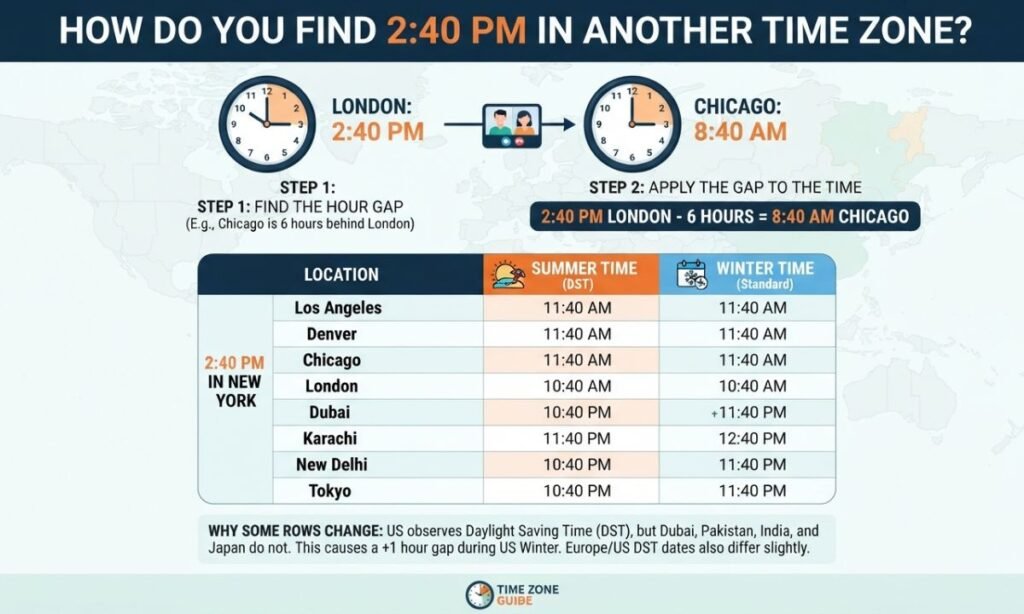
Add or subtract the hour gap between the two places. Do that before you subtract the current time. Say a call starts at 2:40 PM in London. You’re in Chicago, which is six hours behind London. That makes the call 8:40 AM for you. Then use the morning method above to count the wait.
The next table starts from New York. It shows the local time elsewhere when it’s 2:40 PM in New York.
| Place | When US summer time applies | When US winter time applies |
| Los Angeles | 11:40 AM | 11:40 AM |
| Denver | 12:40 PM | 12:40 PM |
| Chicago | 1:40 PM | 1:40 PM |
| London | 7:40 PM | 7:40 PM |
| Dubai | 10:40 PM | 11:40 PM |
| Karachi | 11:40 PM | 12:40 AM (next day) |
| New Delhi | 12:10 AM (next day) | 1:10 AM (next day) |
| Tokyo | 3:40 AM (next day) | 4:40 AM (next day) |
Why do some rows change? The United States and many other countries move their clocks. Dubai, Pakistan, India, and Japan don’t. So the gap grows by an hour when the US returns to standard time.
Europe and the US also change their clocks on different dates. For a week or two in spring and autumn, the London gap can shrink to four hours. If your meeting falls near a clock change, double check the gap. Always confirm with a world clock for anything important. A missed flight costs far more than a minute of checking.
Which tools give an exact countdown?
Your phone already does the work. You just need to set it up once.
- Voice assistant: say “set an alarm for 2:40 PM.” It takes two seconds and fixes the time for you.
- Timer app: enter the hours and minutes you calculated. It counts down to the second.
- Calendar alert: add an event at 2:40 PM and pick a reminder 10 or 15 minutes early.
- Smartwatch: a tap on the wrist is hard to miss in a loud room.
- Online countdown pages: these show the live hours, minutes, and seconds left today.
For something you do daily, make the alarm repeat. A recurring alarm beats remembering every time.
One tip from habit: set the alarm for the time you must start moving, not the time of the event. If you need 20 minutes to get ready, set it for 2:20 PM.
Where does a 2:40 PM deadline show up?
It shows up in school pickups, appointments, shifts, cooking, and travel. Each one has a different cost of being late. Many schools end their day in the mid afternoon, so a 2:40 PM pickup isn’t unusual. Doctor and dentist visits often fall in that slot too. If a clinic books you at 2:40 PM, plan to arrive early for forms.
Here’s a worked example. Your appointment is at 2:40 PM. The drive takes 25 minutes, and parking takes another 10. That’s 35 minutes. Subtract 35 from 2:40 and you get 2:05 PM. That’s when you leave. Cooking works the same way, but backwards. If a dish needs 90 minutes and should be ready at 2:40 PM, start at 1:10 PM. Check: 2:40 minus 1 hour 30 minutes is 1:10.
Medication timing is different. If a doctor or pharmacist gave you a schedule, follow it exactly and use an alarm. Don’t guess the interval from memory. Early afternoon can also feel slow. Many people report an energy dip after lunch. A glass of water, a short walk, or a change of task can make the wait feel shorter.
What are the most common mistakes?
Most errors come from three places: AM and PM, borrowing, and decimals. A quick check catches almost all of them.
- Mixing up AM and PM. 2:40 AM and 2:40 PM are 12 hours apart. Always read the suffix twice.
- Forgetting to borrow 60. When you subtract 50 minutes from 40, you can’t get a negative. Borrow an hour and add 60 first.
- Using decimals. One hour 40 minutes is not 1.40 hours. It’s about 1.67 hours, because 40 divided by 60 is 0.67.
- Ignoring time zones. A meeting invite may show another city’s time. Check which zone the invite uses.
- Skipping the buffer. Arriving at exactly 2:40 PM leaves no room for traffic, lifts, or a late train.
- Trusting a stale clock. Some wall clocks drift by a few minutes. Compare yours with your phone.
A good habit is to do the math twice with two methods. If the count up method and the minutes from midnight method agree, you’re right.
FAQs
How many minutes until 2:40 PM from noon?
There are 160 minutes. That’s 2 hours and 40 minutes.
How long until 2:40 PM if it’s 8:00 AM?
You have 6 hours and 40 minutes. In decimal form, that’s about 6.67 hours.
What is 2:40 PM in military time?
It’s 1440, which you say as “fourteen forty.” On a 24 hour clock, it’s written 14:40.
How long until 2:40 PM if it’s 3:00 PM now?
You have 23 hours and 40 minutes. The next 2:40 PM falls tomorrow.
What is the difference between 2:40 AM and 2:40 PM?
They are exactly 12 hours apart. AM is after midnight, and PM is after noon.
Final thoughts
You don’t need a countdown site to know how long until 2:40 PM. You need your current time, one subtraction, and a quick borrow when the minutes run short. The count up method will carry you through most days.
Right now, check your clock and run the numbers once. Then set an alarm 10 minutes before 2:40 PM so the deadline never sneaks up on you.
Read More Time Guide: