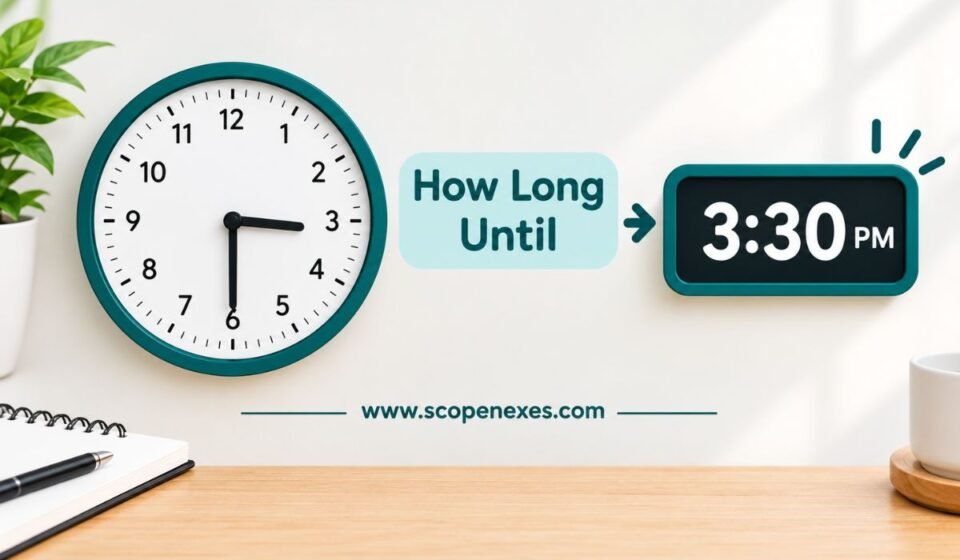

Ever looked at the clock and wondered, How Long Until 3:30 PM? Whether you're waiting for a meeting, planning your afternoon, counting down to the end of work, or simply curious about the time remaining, getting an exact answer can be surprisingly useful.
The live countdown timer above shows you how much time remains until 3:30 PM based on your current time. This guide also explains how to calculate the difference manually, so you can quickly work it out whenever you need to.
Quick Facts: Time Until 3:30 PM
| Detail | Information |
| Target time | 3:30 PM (15:30 in 24 hour format) |
| Common use cases | Work shifts, school dismissal, meetings, flights, appointments |
| Calculation method | Subtract current time from 3:30 PM |
| Time zone dependent | Yes, always confirm local time zone first |
| AM/PM confusion risk | Low, since context usually makes PM clear |
How to Calculate Time Until 3:30 PM
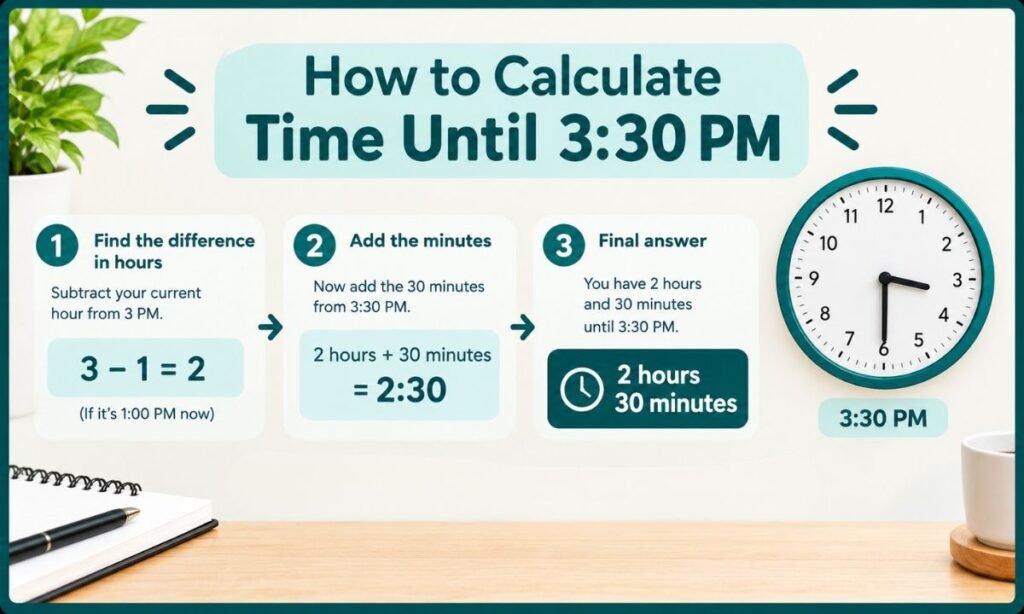
Check the current time, then subtract it from 3:30 PM. That's the whole process.
Here's a simple three step method anyone can use without a calculator.
- Note the current hour and minute. Say it's 12:45 PM right now.
- Subtract the current time from 3:30 PM. From 12:45 PM to 3:30 PM is 2 hours and 45 minutes.
- Double check the math by counting forward. 12:45 PM plus 2 hours is 2:45 PM. Add another 45 minutes and you land right on 3:30 PM.
That third step matters more than people realize. A lot of quick mental math goes wrong at the minute mark, not the hour mark. Minutes don't divide as cleanly as hours do, so a small slip early on throws off the whole result.
Example Calculations Throughout the Day
Seeing a few worked examples makes the pattern click faster than any explanation.
- From 9:00 AM: 6 hours and 30 minutes remain.
- From 11:20 AM: 4 hours and 10 minutes remain.
- From 1:05 PM: 2 hours and 25 minutes remain.
- From 2:47 PM: 43 minutes remain.
- From 3:29 PM: 1 minute remains.
Notice how the gap shrinks fast once you cross into the early afternoon. That's usually when people start refreshing the clock every few minutes, which brings up a whole different problem.
Why People Watch the Clock Toward 3:30 PM
For a huge number of people, 3:30 PM marks a shift. It might be the last stretch of a workday, the moment kids get out of school, or the final push before a scheduled call. Knowing exactly how much runway is left changes how you spend it.
Here's what usually drives the search:
- End of shift countdowns. Retail and hospitality workers often clock out around this time.
- School pickup timing. Many elementary schools dismiss students close to 3:30 PM.
- Meeting prep. A call scheduled for 3:30 PM gives a hard deadline to finish other tasks first.
- Travel connections. Flights, trains, and buses departing at 3:30 PM require precise timing to avoid a mad dash.
- Habit and routine. Some people simply structure their whole afternoon around that number without a specific event attached.
None of these reasons are complicated, but they all share one thing: the closer you get, the more the minutes seem to matter.
Common Mistakes When Tracking Time Until 3:30 PM
People are surprisingly bad at estimating short stretches of time, and there's a name for it. Psychologists call it the planning fallacy, the tendency to think you can finish more in a set window than you actually can.
Here are the mistakes that trip people up most often.
Ignoring the Time Zone
If you're coordinating with someone across the country, "3:30 PM" doesn't mean the same thing to both of you. Always confirm whether the target time is local, or tied to a specific region.
Forgetting AM Versus PM
Most people assume 3:30 refers to the afternoon, since that's when the phrase gets used most. Still, if you're working an overnight shift, double check before you commit to a plan built around the wrong half of the day.
Overestimating Focused Work Time
If the clock says you have an hour left, you probably don't have a full hour of usable focus. Between messages, quick breaks, and mental fatigue, real output often runs closer to 40 or 45 minutes out of every 60. A safer bet is subtracting a buffer of about 10 percent from whatever the countdown shows you.
Skipping Transition Time
Time until 3:30 PM isn't just a number on a screen. If you need five minutes to wrap up, save your work, or walk somewhere, that eats into your actual working window. Build it into your plan instead of discovering it too late.
Read More: How Long Until 11:45 AM? Complete Countdown Guide
Using a Countdown Tool the Smart Way
A countdown widget removes the guesswork entirely. You glance at it, see the hours, minutes, and seconds ticking down, and you know exactly where you stand without doing any arithmetic. That said, tools work best when you use them with a bit of strategy.
- Set a checkpoint, not just an endpoint. If you have two hours left, check your progress at the one hour mark instead of waiting until the final ten minutes.
- Pair it with a task list. A countdown without a plan just creates anxiety. A countdown next to a short list of tasks creates momentum.
- Mute notifications until the last stretch. Constant glances at a ticking timer can actually slow you down by breaking concentration.
- Round down, not up. If the timer shows 52 minutes, treat it like 45. That buffer saves you from the last minute scramble.
Time Until 3:30 PM in a 24 Hour Format
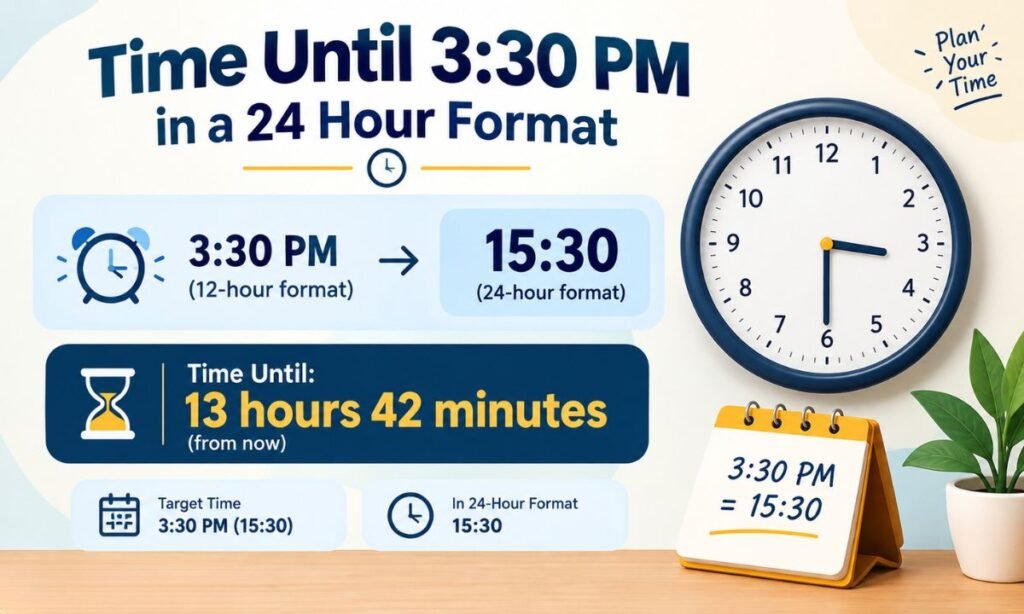
If you're working with international teams or military time, 3:30 PM converts directly to 15:30. This format removes any AM or PM ambiguity altogether, which matters more than people expect when scheduling across borders.
For reference:
- 3:30 AM becomes 03:30
- 3:30 PM becomes 15:30
Using the 24 hour format is especially useful for travel bookings, server logs, and any coordination involving people outside your own time zone. It's one less thing to mix up.
Why the Afternoon Countdown Feels Different
There's a psychological reason 3:30 PM often feels heavier than earlier deadlines. By that point in the day, most people have already burned through their sharpest hours of focus. Energy dips, decision fatigue builds, and the remaining stretch of time feels smaller than it actually is.
Funny enough, the clock doesn't slow down. It just feels that way because your brain is running on fumes by mid afternoon. Knowing this can actually help. Instead of fighting the slump, plan your lightest tasks for the final hour before 3:30 PM and save your sharpest thinking for earlier in the day.
Practical Tips to Make the Countdown Work for You
Rather than treating the time remaining as pressure, use it as a structure.
- Break the remaining time into chunks of 20 to 25 minutes, similar to a Pomodoro cycle.
- Set one clear goal for each chunk instead of a vague "get more done" mindset.
- Reward yourself with a short break once you hit the 3:30 PM mark, even if it's just stepping away from the screen.
- If the countdown is tied to an appointment or flight, add a personal buffer of 10 to 15 minutes so you're never cutting it close.
Small adjustments like these turn a stressful countdown into a manageable one.
Frequently Asked Questions
How do I calculate the time left until 3:30 PM?
Subtract the current time from 3:30 PM. At 1:00 PM, for example, you'd have 2 hours and 30 minutes remaining.
What is 3:30 PM in 24 hour time?
3:30 PM converts to 15:30 in the 24 hour clock format, removing any AM or PM confusion.
Why do people search for time until 3:30 PM so often?
It usually lines up with shift changes, school pickup, meetings, or travel departures scheduled around that hour.
Is there a difference between 3:30 AM and 3:30 PM countdowns?
Yes, the two are 12 hours apart, so always confirm which one applies before planning around it.
Can I trust a countdown timer for scheduling important events?
Yes, as long as the timer reflects the correct time zone and you add a small personal buffer for transitions.
Final Thoughts
Figuring out how long until 3:30 PM comes down to one simple subtraction, but how you use that stretch of time makes all the difference.
Whether you're closing out a workday, prepping for a call, or just watching the clock until pickup time, knowing the exact gap helps you plan with a little more confidence and a lot less last minute scrambling.