
If you've typed how long until 2 PM into a search bar, you're probably watching the clock for a reason: a break, a meeting, or just the end of a long stretch of work.
That question shows up more often than people expect, especially once the morning starts dragging. This guide breaks down the math, the tools, and the everyday reasons behind it, all in plain, simple language.
What Does 2 PM Actually Mean?
2 PM sits right in the middle of a standard afternoon. In 24 hour time, it reads as 14:00. It's two hours past noon, which makes it a natural marker for lunch wrap ups, midday meetings, and school dismissal times in many regions.
A quick mental note: if you ever see "14:00" on a schedule, that's your 2 PM. Airlines, hospitals, and military schedules almost always use this format, so knowing the conversion saves you from double checking every single time.
How to Calculate the Time Until 2 PM Manually
You don't need an app to figure this out. Grab the current time and follow these steps.
- Check your current time. Look at your phone, computer, or wall clock.
- Convert to 24 hour format if needed. For example, 9:30 AM stays 9:30, but 9:30 PM becomes 21:30.
- Subtract from 14:00. If it's currently 11:15, subtract 11:15 from 14:00. That leaves 2 hours and 45 minutes.
- Adjust for minutes. If your current minutes are higher than the target minutes, borrow an hour. Say it's 1:40 PM (13:40). Subtracting from 14:00 gives you 20 minutes.
A Worked Example
Say the clock reads 10:07 AM right now. Subtract 10:07 from 14:00, and you land on 3 hours and 53 minutes left until 2 PM hits. Try the same steps with your own current time, and you'll get the hang of it within a minute or two.
Time Until 2 PM at a Glance
| Current Time | Time Left Until 2 PM |
| 8:00 AM | 6 hours |
| 9:00 AM | 5 hours |
| 10:00 AM | 4 hours |
| 11:00 AM | 3 hours |
| 12:00 PM | 2 hours |
| 1:00 PM | 1 hour |
| 1:45 PM | 15 minutes |
This table gives a rough estimate. Minutes will shift the exact number slightly, so treat it as a fast reference rather than a precise reading.
Why People Search "How Long Until 2 PM"
This question shows up for more reasons than you'd guess.
- Work schedules. Many shifts, breaks, and meetings get anchored around 2 PM.
- School dismissal. Several school districts release students close to this hour.
- Cooking and baking. Recipes with long roasting or resting times often finish around this mark.
- Fasting windows. People following intermittent fasting plans track their eating window closing near 2 PM.
- Appointment timing. Travelers and patients count down to a scheduled slot.
- Gaming events. Online game servers often reset or launch events at set clock times, and 2 PM is a popular pick.
Each of these situations turns a simple time check into something worth searching, especially when you're mid task and don't want to stop and do the math yourself.
Read More: How Long Until 1:20 PM? Full Countdown and Time Guide
Common Mistakes When Calculating Time Until 2 PM
- Mixing up AM and PM. Forgetting whether the current time is before or after noon throws off the whole calculation.
- Ignoring time zones. "2 PM" might not mean the same clock time for someone in another region.
- Skipping the minute adjustment. Rounding hours without accounting for minutes leads to sloppy estimates.
- Forgetting daylight saving shifts. Right after clocks change, the gap can feel off by an hour.
- Using outdated device clocks. A phone with a wrong system time throws every calculation off.
Watch for these, and your countdown stays accurate every single time.
Tools You Can Use to Track the Countdown
- Phone clock apps. Most smartphones let you set a countdown or alarm for a specific time.
- Browser countdown widgets. Many websites offer live countdown timers you can bookmark.
- Calendar reminders. Set an event for 2 PM and let your calendar app calculate the remaining time.
- Smart speakers. Asking a voice assistant "how long until 2 PM" gives you an instant answer.
- Spreadsheet formulas. For repeated calculations, a simple time subtraction formula does the trick.
Each option suits a different habit, so pick whichever fits your daily routine best.
Why 2 PM Matters in a Typical Day
For most people, 2 PM lands right after lunch, when energy naturally dips. Researchers call this the post lunch slump, and it hits many of us right around this hour, regardless of what we ate.
Meetings scheduled at 2 PM often try to work around that dip by staying short and focused. Teachers plan afternoon lessons with this slump in mind too, mixing in more interactive activities to keep students alert and engaged.
For early risers who've already cleared their morning tasks, 2 PM becomes a natural point to reset, grab a coffee, and tackle the second half of the day with fresh focus. It's also a common time for shift changes in retail and hospitality, which is part of why so many workplaces treat it as a soft dividing line.
Using 2 PM as a Time Management Anchor
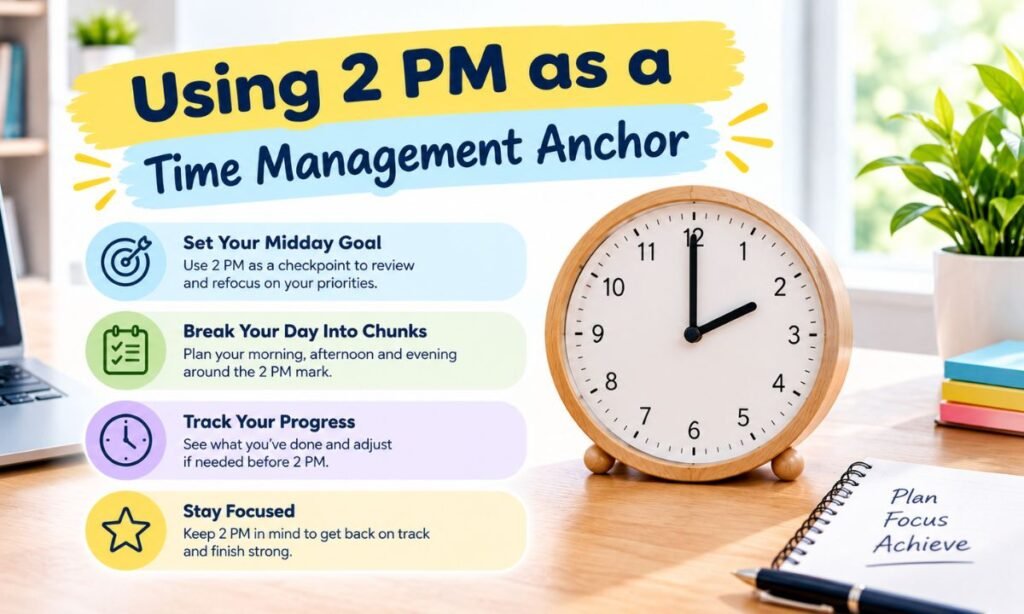
Beyond just counting down, 2 PM works well as a planning tool. Try building your day around it.
- Set major tasks for before 2 PM, when focus tends to run higher for most people.
- Save lighter, routine work for after 2 PM to match the natural energy dip.
- Use 2 PM as a check in point to review your to do list and adjust priorities.
- Schedule a short walk or stretch break right around this time to counter the afternoon slump.
Small adjustments like these turn a random clock number into a genuinely useful marker for your daily rhythm.
2 PM Around Different Time Zones
A call booked for 2 PM Eastern time lands very differently for someone on the West Coast or overseas. Here's a rough comparison to keep handy.
| Zone | Local Time When It's 2 PM Eastern |
| Pacific | 11:00 AM |
| Central | 1:00 PM |
| Mountain | 12:00 PM |
| GMT (London) | 7:00 PM |
Numbers shift with daylight saving changes, so treat this as a starting point rather than a fixed rule.
A Sample Afternoon Built Around 2 PM
Here's how a typical workday might look when you treat 2 PM as a hinge point rather than just another number on the clock.
- 12:00 PM to 1:00 PM: Lunch break, ideally away from your desk.
- 1:00 PM to 2:00 PM: Light administrative work, emails, and quick catch ups.
- 2:00 PM: Reset point. Grab water or coffee, glance at your afternoon list.
- 2:00 PM to 4:00 PM: Focused work block, since energy often rebounds slightly after the initial slump passes.
- 4:00 PM onward: Wind down tasks, planning for the next day.
This isn't a rigid formula, but it shows how a single time stamp can shape the structure of several hours around it.
Times Often Confused With 2 PM
A few nearby times trip people up because they look or sound similar on a busy schedule.
- 2 AM versus 2 PM. Always double check the AM or PM label, especially on printed schedules.
- 12:00 PM versus 2:00 PM. Noon and 2 PM sit only two hours apart, but mixing them up on a calendar invite causes real scheduling headaches.
- 14:00 versus 4:00 PM. Since 14:00 in 24 hour format equals 2 PM, not 4 PM, this mix up happens more than you'd expect among people new to reading military time.
Keeping these distinctions clear avoids a surprising number of missed meetings and mistimed tasks.
Frequently Asked Questions
How many hours are there from 9 AM to 2 PM?
There are exactly 5 hours between 9 AM and 2 PM.
Is 2 PM the same as 14:00?
Yes, 2 PM matches 14:00 in 24 hour time format.
Why does 2 PM feel so tiring for many people?
The post lunch energy dip often peaks around this hour, making focus harder.
Can I set a countdown timer for 2 PM on my phone?
Most phones let you set an alarm or countdown for any specific clock time, including 2 PM.
Does 2 PM change with daylight saving time?
The clock number stays the same, but the actual daylight hours shift depending on the season and your local rules.
Conclusion
Figuring out how long until 2 PM doesn't need to be complicated. Whether you do quick mental subtraction or lean on an app, the goal stays the same: knowing exactly how much time you have left to finish a task, catch a break, or prepare for whatever comes next. Keep the manual method in your back pocket for moments without internet access, and let digital tools handle the rest when speed matters more.
Once you've practiced the subtraction a few times, checking the gap between now and 2 PM becomes second nature. You stop reaching for a calculator and start doing it in your head while pouring your morning coffee. That small skill, simple as it sounds, saves a surprising number of minutes over a busy week, and it keeps you a step ahead of whatever that 2 PM mark means for your particular day.