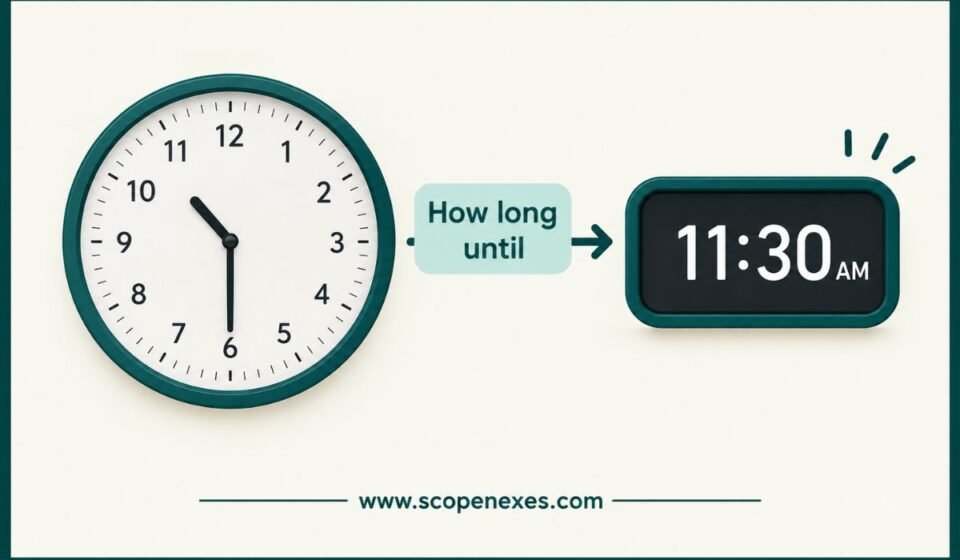

Ever caught yourself glancing at the clock and wondering exactly how long until 11:30? You're not alone. Whether you're watching the minutes crawl before a lunch break, a flight, or a scheduled call, this question pops up constantly.
The good news is the math behind it is simple once you know the trick. This guide walks you through the calculation, clears up the AM versus PM confusion, and shows you why your brain seems to slow the clock down on purpose.
What Does "How Long Until 11:30" Actually Mean
It means finding the gap between right now and the next time the clock reads 11:30, whether that's morning or night.
The tricky part isn't the math. It's the missing detail: AM or PM. Without that piece, your answer could be off by twelve hours. So before you calculate anything, pin down which 11:30 you're aiming for. A doctor's appointment at 11:30 AM behaves nothing like a flight departing at 11:30 PM, even though the numbers on the clock look identical.
Quick Facts Table
Here's a snapshot you can scan in seconds instead of doing mental math every time.
| Current Time | Time Until 11:30 AM | Time Until 11:30 PM |
| 8:00 AM | 3 hours 30 minutes | 15 hours 30 minutes |
| 9:15 AM | 2 hours 15 minutes | 14 hours 15 minutes |
| 10:00 AM | 1 hour 30 minutes | 13 hours 30 minutes |
| 11:00 AM | 30 minutes | 12 hours 30 minutes |
| 2:00 PM | 21 hours 30 minutes | 9 hours 30 minutes |
| 9:45 PM | 13 hours 45 minutes | 1 hour 45 minutes |
Bookmark this table if you check the time often during your workday. It saves you from redoing the subtraction every single time.
How to Calculate Time Until 11:30 Manually
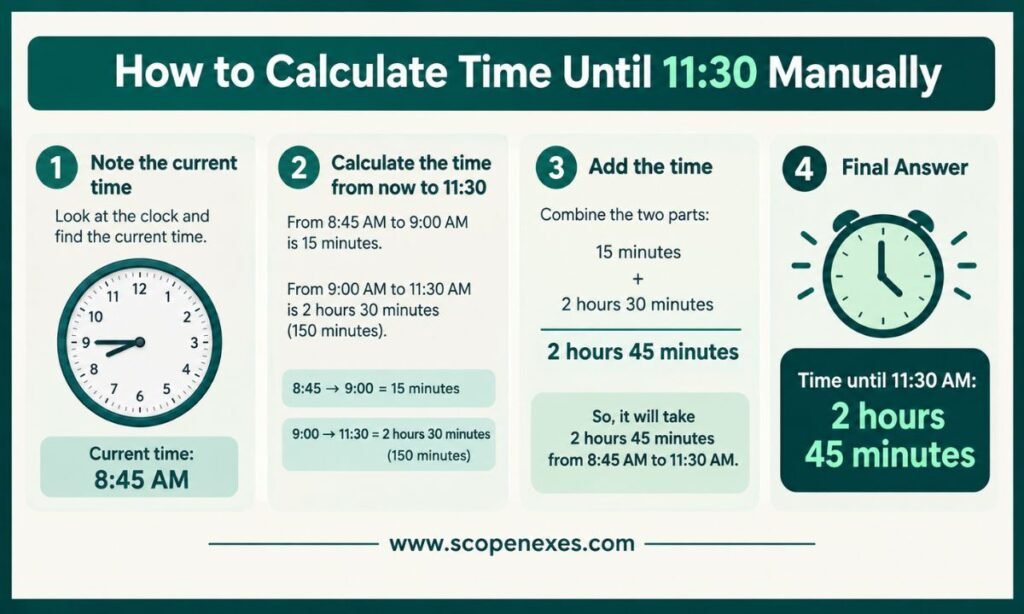
You don't need an app for this. A basic three-step method gets you there every time.
- Write down your current time. Say it's 9:40 AM.
- Find the gap to the next full hour. From 9:40 to 10:00 is 20 minutes.
- Add the remaining stretch to 11:30. From 10:00 to 11:30 is 1 hour 30 minutes. Add that to your first 20 minutes, and you land on 1 hour 50 minutes total.
That's it. Break the problem into two smaller jumps instead of one big subtraction, and the numbers stop feeling intimidating.
Here's another version of the same trick, useful when the current time falls after 11:30:
- Subtract 11:30 from your current time to see how far past it you are.
- Subtract that result from 24 hours if you're counting toward the next day's 11:30.
- Double check by adding your answer back to the current time. It should land exactly on 11:30.
This habit of checking your own math might feel unnecessary, but it catches small errors before they turn into a missed appointment.
Why AM and PM Confusion Causes Real Problems
A missed flight, a skipped call, or an awkward late arrival often traces back to one thing: nobody said AM or PM out loud.
Picture this. A friend texts "meet me at 11:30" with no context. You show up at night. They meant morning. Now you've wasted half a day and an evening waiting on each other. It sounds like a small mistake, but scheduling errors like this happen constantly in workplaces, hospitals, and airports.
Here's a habit worth building: always write out the full time when you're texting, emailing, or setting a reminder. "11:30 AM" takes two extra characters and saves you a world of confusion later.
Common Situations Where People Ask This Question
People search for "how long until 11:30" for a surprising range of reasons. A few of the most common:
- Work meetings. You're counting down to a scheduled call or a standup.
- Lunch breaks. For many office workers, 11:30 marks the start of the earliest lunch slot.
- Flights and trains. Boarding times listed at 11:30 create real pressure to track the countdown.
- Cooking and baking. A recipe that needs to finish by 11:30 requires backward planning.
- Workouts and classes. Gym sessions or yoga classes often start on the half hour.
- Medication schedules. Some routines call for a dose at a specific time, and 11:30 is a common slot for a midday reminder.
Notice how different these situations are. Yet they all boil down to the same underlying question: how much runway do I have left?
Tips to Stop Obsessively Watching the Clock
Counting down the minutes can quietly drain your focus. A few small adjustments help you stay productive instead of anxious.
- Set one alarm and forget the clock. Let your phone do the watching so your brain doesn't have to.
- Break the wait into chunks. Instead of staring at "2 hours left," think "20 minutes of emails, then a short break."
- Use a visible timer for short waits. For anything under 30 minutes, a simple countdown app removes the guesswork.
- Avoid refreshing the clock every few seconds. Checking constantly makes time feel slower, not faster.
- Plan your next task before the wait even starts. Momentum beats watching.
Small shifts like these turn a stressful countdown into background noise you barely notice.
Why Time Feels Slower When You're Waiting
You've probably noticed that five minutes of boredom feels longer than five minutes of something fun. That's not just in your head.
Your brain estimates time using activity and novelty, not an internal stopwatch. When nothing new is happening, your mind has fewer moments to anchor onto, so the gap between now and 11:30 feels stretched out. Give your brain something engaging to chew on, even something small like a quick task or a conversation, and the same 20 minutes seems to vanish.
This is why people who work through the wait tend to reach 11:30 without noticing, while people who just watch the clock feel every second crawl.
Frequently Asked Questions
How do I quickly calculate the time until 11:30?
Subtract your current time from 11:30, breaking it into the gap to the next hour, then adding the rest.
Does 11:30 usually mean AM or PM?
It depends entirely on context. Always confirm which one, since the two are twelve hours apart.
Why does waiting for a specific time feel slower than it actually is?
Boredom reduces the mental "anchors" your brain uses to track time, so gaps without activity feel stretched.
What's the fastest way to avoid AM and PM mixups?
Always write or say the full time, including AM or PM, instead of just the numbers.
Can I set a reminder instead of manually calculating the time?
Yes. A single phone alarm or countdown timer removes the need for repeated mental math.
Conclusion
Figuring out how long until 11:30 really comes down to two things: knowing whether you mean morning or night, and breaking the math into smaller, manageable jumps. Once you've got the calculation down, the bigger win is managing how that waiting time feels.
Fill it with something worthwhile, set a single reminder, and let the clock take care of itself. You'll reach 11:30 before you know it, calculation solved and stress avoided.