
The time left until 5:30 is the gap between your clock and 5:30. Subtract the current time from 5:30. If 5:30 has already passed today, add 24 hours to the answer.
That is the whole method. This guide shows how long until 5:30 AM and 5:30 PM from common start times. You’ll also get worked examples, quick tables, and the mistakes that trip people up.
How do you work out how long until 5:30?
Convert both times to the 24 hour clock, then subtract. The result is your wait in hours and minutes.
Follow these steps:
- Write down the current time.
- If it’s a PM time, add 12 to the hour. AM hours stay as they are.
- Convert 5:30 the same way. Morning is 05:30 and evening is 17:30.
- Subtract the current time from 5:30.
- If the minutes go negative, borrow one hour and add 60 minutes.
Take 2:10 PM as an example. That is 14:10 on the 24 hour clock. Subtract it from 17:30 and you get 3 hours 20 minutes.
Here’s a case where borrowing matters. Say it’s 1:45 PM, or 13:45. You can’t take 45 minutes from 30. So turn 17:30 into 16 hours and 90 minutes. Now subtract 13:45 to get 3 hours 45 minutes.
How do you convert 12 hour times to 24 hour times?
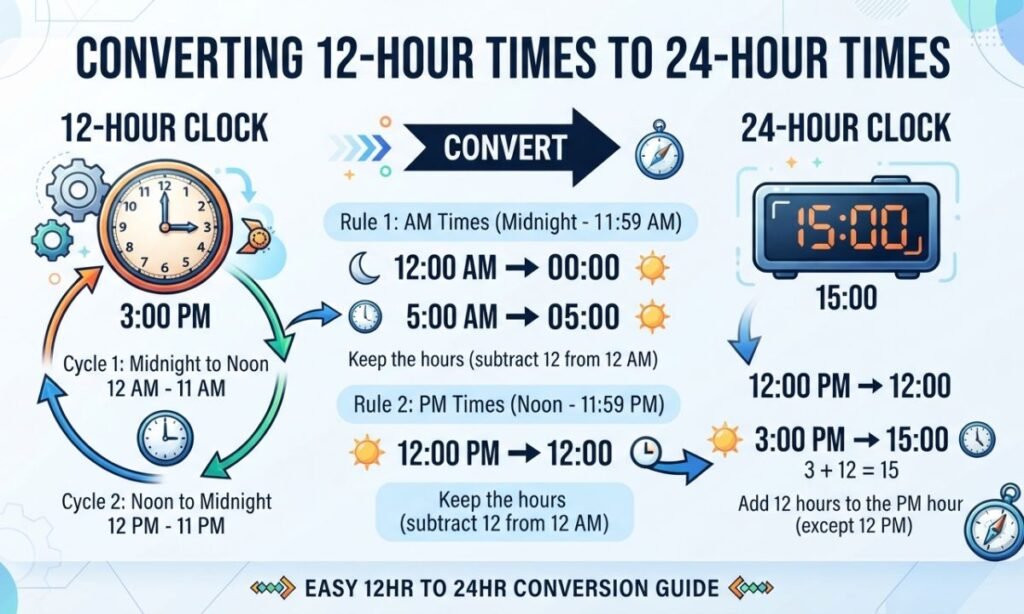
For PM times, add 12 to the hour. AM times keep the same number, except 12 AM, which becomes 00.
By convention, 12 AM means midnight and 12 PM means noon. Many people find that backward at first. Writing “12 noon” or “12 midnight” removes the doubt.
| 12 hour time | 24 hour time |
| 12:00 AM (midnight) | 00:00 |
| 5:30 AM | 05:30 |
| 12:00 PM (noon) | 12:00 |
| 1:00 PM | 13:00 |
| 2:00 PM | 14:00 |
| 3:00 PM | 15:00 |
| 4:00 PM | 16:00 |
| 5:30 PM | 17:30 |
| 6:00 PM | 18:00 |
| 9:00 PM | 21:00 |
| 11:00 PM | 23:00 |
Is it 5:30 AM or 5:30 PM?
Pick whichever 5:30 arrives next on your clock. At 3 PM, the next one is 5:30 PM. At 9 PM, the next one is 5:30 AM.
Context helps too. A shift that ends at 5:30 is probably an evening time. A gym class at 5:30 could be either one. When the label is missing, ask. A wrong guess costs you exactly 12 hours.
Here is how the two versions look in other formats.
| Time | 24 hour format | Military style | Minutes after midnight | Seconds after midnight |
| 5:30 AM | 05:30 | 0530 | 330 | 19,800 |
| 5:30 PM | 17:30 | 1730 | 1,050 | 63,000 |
Military style just drops the colon. You read 1730 as “seventeen thirty.”
How many minutes and seconds are in the wait?
Multiply the hours by 60, then add the leftover minutes. A wait of 3 hours 20 minutes is 200 minutes. Multiply by 60 again and you get 12,000 seconds.
There’s a cleaner path that skips borrowing. Turn each time into minutes after midnight. The 5:30 PM mark is 1,050 minutes. The 5:30 AM mark is 330 minutes.
Now test it at 2:10 PM. That is 14 times 60 plus 10, or 850 minutes. Subtract 850 from 1,050 and you get 200. Divide by 60 for 3 hours with 20 minutes left over.
Watch out for decimals. A wait of 3 hours 20 minutes is about 3.33 hours, not 3.2. Every 6 minutes equals 0.1 of an hour.
How far into the day is 5:30?
5:30 PM sits about 72.9 percent of the way through the day. 5:30 AM sits about 22.9 percent through.
The math is simple. A day has 1,440 minutes. Divide 1,050 by 1,440 for the evening mark. Divide 330 by 1,440 for the morning mark.
How long until 5:30 PM from common start times?
From noon, the wait is 5 hours 30 minutes. Each hour later takes one hour off.
| Current time | Wait until 5:30 PM | Total minutes |
| 8:00 AM | 9 hours 30 minutes | 570 |
| 9:00 AM | 8 hours 30 minutes | 510 |
| 10:00 AM | 7 hours 30 minutes | 450 |
| 11:00 AM | 6 hours 30 minutes | 390 |
| 12:00 PM | 5 hours 30 minutes | 330 |
| 1:00 PM | 4 hours 30 minutes | 270 |
| 2:00 PM | 3 hours 30 minutes | 210 |
| 3:00 PM | 2 hours 30 minutes | 150 |
| 4:00 PM | 1 hour 30 minutes | 90 |
| 5:00 PM | 30 minutes | 30 |
Your start time isn’t on the hour? Adjust the wait by the extra minutes. At 2:15 PM, take 15 minutes off the 2:00 PM wait. That gives 3 hours 15 minutes.
Here are a few starts with odd minutes.
| Current time | Wait until 5:30 PM |
| 9:40 AM | 7 hours 50 minutes |
| 10:25 AM | 7 hours 5 minutes |
| 1:15 PM | 4 hours 15 minutes |
| 2:45 PM | 2 hours 45 minutes |
| 3:20 PM | 2 hours 10 minutes |
| 4:50 PM | 40 minutes |
How long until 5:30 AM from common start times?
From midnight, the wait is 5 hours 30 minutes. Each hour later takes one hour off.
| Current time | Wait until 5:30 AM | Total minutes |
| 9:00 PM | 8 hours 30 minutes | 510 |
| 10:00 PM | 7 hours 30 minutes | 450 |
| 11:00 PM | 6 hours 30 minutes | 390 |
| 12:00 AM | 5 hours 30 minutes | 330 |
| 1:00 AM | 4 hours 30 minutes | 270 |
| 2:00 AM | 3 hours 30 minutes | 210 |
| 3:00 AM | 2 hours 30 minutes | 150 |
| 4:00 AM | 1 hour 30 minutes | 90 |
| 5:00 AM | 30 minutes | 30 |
What if 5:30 already passed today?
Add 24 hours to your subtraction result. That gives the wait until the next 5:30.
Say it’s 6:00 PM. Subtracting 18:00 from 17:30 leaves negative 30 minutes. Add 24 hours and you get 23 hours 30 minutes.
Try a morning case. It’s 6:15 AM and you want the next 5:30 AM. Subtracting 06:15 from 05:30 leaves negative 45 minutes. Add 24 hours. The wait is 23 hours 15 minutes.
What if it’s exactly 5:30 right now? The wait for today is zero. The next one is a full 24 hours away.
Read More: How Long Until 3:30 PM? Quick Countdown Guide
How do you count past midnight?
Split the trip at midnight. Count to 12:00 AM first, then count from midnight to your target.
Start with 8:20 PM and aim for 5:30 AM. From 8:20 PM to midnight is 3 hours 40 minutes. From midnight to 5:30 AM is 5 hours 30 minutes. The total is 9 hours 10 minutes.
Try 11:50 PM. That is 10 minutes to midnight. Add 5 hours 30 minutes and the wait is 5 hours 40 minutes.
The same trick works for a 5:30 PM that falls tomorrow. From 9:00 PM tonight, count 3 hours to midnight. Then add 17 hours 30 minutes. The total is 20 hours 30 minutes.
What is the easiest mental math trick?
Use the hop method. Hop to the next full hour, then jump to 5:30. It avoids borrowing and works from any start time.
Start at 2:10 PM. Hop 50 minutes to 3:00. Jump 2 hours to 5:00. Add the last 30 minutes. Together the pieces make 3 hours 20 minutes.
Try 11:25 AM. Hop 35 minutes to noon. From noon, 5:30 PM is always 5 hours 30 minutes away. Add them and the wait is 6 hours 5 minutes.
Noon is your best anchor for a PM target. Midnight is the anchor for an AM target. Each one sits exactly 5 hours 30 minutes from 5:30.
Use the hop method for short waits. Use total minutes for long waits or overnight ones.
How do you count backward from 5:30?
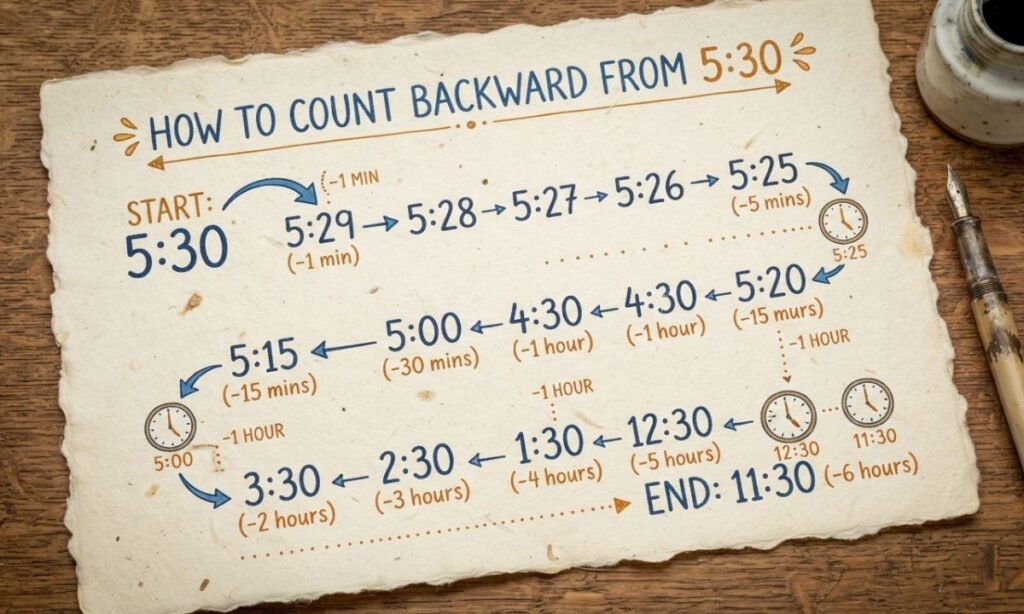
Subtract your time needs from 5:30 to find the latest start. Hours come off first, then minutes.
Say a task takes 1 hour 20 minutes and must finish by 5:30 PM. Start no later than 4:10 PM. A commute of 35 minutes means you leave by 4:55 PM.
Now flip it to the morning. You want 8 hours of sleep before a 5:30 AM alarm. Count back 8 hours to 9:30 PM. That is your bedtime.
Add a buffer to any plan. Ten or fifteen extra minutes covers small delays.
How can you get a live countdown to 5:30?
Set an alarm or timer, or use a spreadsheet formula. Each shows the exact time left without mental math.
Ask your voice assistant to set an alarm for 5:30. It picks the next 5:30 for you. Many phones also show the time left until an alarm rings when you set it.
Online countdown pages tick down in hours, minutes, and seconds. Some can send a notification when the moment arrives, even if the tab sits in the background.
Prefer a spreadsheet? Paste this formula into a cell.
=MOD(TIME(17,30,0)-MOD(NOW(),1),1)
Format the cell as [h]:mm. Change 17 to 5 for the morning version. The inner MOD strips the date from NOW. The outer MOD wraps the answer to tomorrow when 5:30 has passed.
Spreadsheets store time as a fraction of a day. That is why the format step matters. Skip it and you’ll see a strange decimal.
Does daylight saving time change the wait?
Yes, but only on the two nights the clocks change. On those nights the real wait differs from the clock math by one hour.
In most of the United States, clocks jump forward at 2 AM on the second Sunday in March. They fall back at 2 AM on the first Sunday in November. In 2026 those dates are March 8 and November 1.
Take the fall back night. At 10:00 PM on Saturday, clock math says 7 hours 30 minutes until 5:30 AM. The real wait is 8 hours 30 minutes, because one hour happens twice. On the spring night, the real wait drops to 6 hours 30 minutes.
Other regions use different dates. Some places, including India, skip daylight saving entirely. Check local rules before you trust the math across a change.
How do time zones change 5:30?
A 5:30 in another city is a different moment for you. Convert it through UTC, then move to your own zone.
Subtract the city’s offset to get UTC. Then add your own offset. For example, 5:30 PM in India uses UTC+5:30. Subtract 5 hours 30 minutes and you reach 12:00 noon UTC.
The table below shows the local time in each place when it is 5:30 PM in India. It uses standard time offsets.
| Place | Standard offset | Local time when it is 5:30 PM in India |
| Pakistan | UTC+5 | 5:00 PM |
| United Arab Emirates | UTC+4 | 4:00 PM |
| United Kingdom, winter | UTC+0 | 12:00 PM |
| Central Europe, winter | UTC+1 | 1:00 PM |
| US Eastern, winter | UTC minus 5 | 7:00 AM |
| US Pacific, winter | UTC minus 8 | 4:00 AM |
| Japan | UTC+9 | 9:00 PM |
| Sydney, standard time | UTC+10 | 10:00 PM |
Places with daylight saving shift by an hour in summer. The UK moves to UTC+1. US Eastern moves to UTC minus 4. Check the date first.
Half hour offsets cause the most errors. UTC+5:30 is one. India and Sri Lanka both use it. Nepal sits at UTC+5:45, a quarter hour further along. A colleague who says 5:30 their time needs the UTC step. Adding whole hours won’t be enough.
Why do people ask how long until 5:30?
Most often it’s the end of the workday. The wait to 5:30 PM shapes lunch breaks, commutes, and pickups.
A 9 AM start and a 5:30 PM finish make an 8 hour 30 minute day. That is 510 minutes. Take out an unpaid 30 minute lunch and paid time is 8 hours. It’s a handy check against a timesheet.
Other reasons come up daily. School or daycare pickup. A dinner booking. A train departure. An early alarm for a run or a flight. The math is the same each time. Only the start time changes.
What mistakes should you avoid?
Most errors come from AM and PM labels, midnight, and minutes. These are the ones that catch people most often.
- Mixing up 12 AM and 12 PM. Midnight is 12 AM and noon is 12 PM.
- Skipping midnight. An evening time subtracted from a morning time goes negative. Add 24 hours to fix it.
- Treating minutes as decimals. A wait of 3 hours 20 minutes is not 3.2 hours.
- Picking the wrong 5:30. Confirm AM or PM, especially for flights and calls.
- Ignoring time zones. A 5:30 call in another city may land at an odd hour for you.
- Trusting clock math on a change night. Add or remove one hour when daylight saving starts or ends.
Frequently asked questions
How many hours until 5:30 PM from noon?
It is 5 hours 30 minutes, or 330 minutes. In decimal form that is 5.5 hours.
How long is it from 5:30 AM to 5:30 PM?
Exactly 12 hours. That equals 720 minutes.
How many hours is 9 to 5:30?
It is 8 hours 30 minutes, or 8.5 hours. Take away a 30 minute lunch and you get 8 hours.
What is 5:30 PM in 24 hour time?
It is 17:30. Military style writes it as 1730.
How do I set a countdown to 5:30?
Set an alarm for 5:30 on your phone, or use the spreadsheet formula above. Either one does the math for you.
Put the 5:30 countdown to work
Now you know how long until 5:30 from any start time. Pick one time you check often, such as your lunch break. Work it out with the hop method today.
After a few tries it takes seconds. For a live number, set an alarm or paste the spreadsheet formula. Then test the wait again on the next clock change night. That one habit prevents the classic off by one hour mistake.