
The time left until 6 PM is 6:00 PM minus the time on your clock right now. At 3:00 PM you have 3 hours. At 3:40 PM you have 2 hours and 20 minutes.
That math takes about ten seconds once you know the trick. This guide covers the quick methods, a few tables worth bookmarking, and the traps that catch people. You’ll also see how time zones and daylight saving time can change your answer.
How do you calculate how long until 6 PM?
Subtract the current time from 6:00 PM, then adjust for any minutes. Whole hours are easy. Minutes are where most people slip.
Here is the process:
- Read your clock, including the minutes.
- If the minutes are zero, subtract the hour from 6.
- If there are minutes, count up to the next full hour first.
- Add the full hours between that point and 6:00.
Take 2:15 PM. It’s 45 minutes to 3:00 PM. Then you have 3 more hours to reach 6:00 PM. The total is 3 hours and 45 minutes.
What is the borrow method?
The borrow method turns 6:00 into 5:60, then subtracts the usual way. You borrow one hour and cash it in as 60 minutes.
Try 2:15 PM again. 5:60 minus 2:15 leaves 3:45. Now try 4:50 PM. 5:60 minus 4:50 leaves 1:10.
Check that against common sense. Ten minutes gets you to 5:00. One more hour gets you to 6:00. Same answer.
What is the count up method?
The count up method walks from your time to 6 PM in small steps. First reach the next round hour. Then jump ahead by whole hours.
This one works best for mental math. You never subtract a messy number. You only add small, friendly ones.
At 1:40 PM, you need 20 minutes to reach 2:00 PM. Then you need 4 hours to reach 6:00 PM. You have 4 hours and 20 minutes.
How can you estimate with a clock face?
Point at the hour hand and count the numbers up to 6. Each number you pass is one hour. It works best on an analog clock, and it needs no math at all.
At 2:00 the hour hand sits on the 2. Count 3, 4, 5, 6 and you get 4 hours. If the hand sits halfway between the 2 and the 3, you have about 3 and a half hours left.
The result is a rough figure. Use it when you only need a feel for the time, like deciding whether to start a long task.
How much time is left at each hour of the day?
Each full hour gives a clean answer, and the table below covers the daytime. Find your hour and read across.
| Time now | Time left until 6 PM |
| 6:00 AM | 12 hours |
| 7:00 AM | 11 hours |
| 8:00 AM | 10 hours |
| 9:00 AM | 9 hours |
| 10:00 AM | 8 hours |
| 11:00 AM | 7 hours |
| 12:00 PM (noon) | 6 hours |
| 1:00 PM | 5 hours |
| 2:00 PM | 4 hours |
| 3:00 PM | 3 hours |
| 4:00 PM | 2 hours |
| 5:00 PM | 1 hour |
Your clock probably doesn’t land on the hour. For a half hour time, take the answer for the hour and subtract 30 minutes. At 1:30 PM, start from 5 hours and subtract 30 minutes. You get 4 hours and 30 minutes.
How long until 6 PM when it’s still morning?
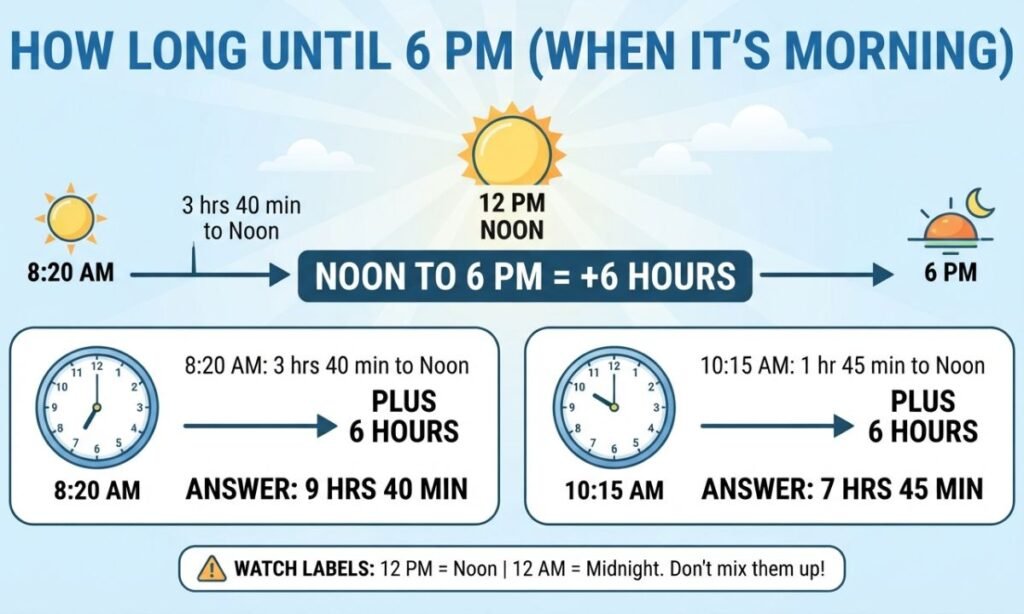
Count to noon first, then add 6 hours. Noon to 6 PM is always exactly 6 hours.
- At 8:20 AM you have 3 hours and 40 minutes to noon. Add 6 hours and the answer is 9 hours and 40 minutes.
- At 10:15 AM you have 1 hour and 45 minutes to noon. The total is 7 hours and 45 minutes.
Watch the labels here. 12 PM means noon. 12 AM means midnight. Mixing them up throws your answer off by a full 12 hours.
How do you work it out on a 24 hour clock?
Convert 6 PM to 18:00, then subtract your time from it. The method stays the same. Only the numbers look different.
At 14:30, 18:00 minus 14:30 is 3 hours and 30 minutes. At 09:45, use the borrow method. 17:60 minus 09:45 leaves 8 hours and 15 minutes. At 16:20, you have 1 hour and 40 minutes.
If your reading is past 12:00, subtract 12 to get the PM hour. So 15:00 is 3:00 PM. This is a handy check when a schedule uses military style times.
Read More: How Long Until 2:50 PM? Quick Countdown & Time Calculator
How many minutes and seconds are left until 6 PM?
Multiply the hours by 60 to get minutes. Multiply the minutes by 60 to get seconds. Most people only need minutes, but a countdown can be fun in seconds.
Say you have 3 hours and 45 minutes left. That is (3 × 60) + 45, which equals 225 minutes. Multiply 225 by 60 and you get 13,500 seconds.
Here are a few common gaps:
| Time left | Minutes | Seconds |
| 2 hours | 120 | 7,200 |
| 1 hour 30 minutes | 90 | 5,400 |
| 45 minutes | 45 | 2,700 |
| 15 minutes | 15 | 900 |
What if 6 PM has already passed today?
You’re now counting to 6 PM tomorrow, so subtract the time since 6 PM from 24 hours. A full day holds 24 hours. That number is your anchor.
At 7:30 PM, 1 hour and 30 minutes have passed since 6:00. Then 24 hours minus 1 hour 30 minutes leaves 22 hours and 30 minutes.
There is a second route. Count the hours to midnight, then add 18. At 8:00 PM you have 4 hours to midnight. Add 18 and you get 22 hours.
| Time now | Time left until 6 PM tomorrow |
| 7:00 PM | 23 hours |
| 8:00 PM | 22 hours |
| 9:00 PM | 21 hours |
| 10:00 PM | 20 hours |
| 11:00 PM | 19 hours |
| 12:00 AM (midnight) | 18 hours |
How long until 6 PM on a date days away?
Count the full days, multiply by 24, then add the gap between your time and 6 PM. Days are just big blocks of 24 hours. Treat them that way and the rest is the same small sum.
Say it’s Monday at 2:00 PM and your event is Thursday at 6:00 PM. Monday 2:00 PM to Thursday 2:00 PM is 3 days, or 72 hours. Add 4 more hours to reach 6:00 PM. You have 76 hours.
Try one that crosses a morning. It’s Friday at 9:00 AM and the event is Saturday at 6:00 PM. Friday 9:00 AM to Saturday 9:00 AM is 24 hours. Add 9 hours to reach 6:00 PM. You have 33 hours.
Long countdowns can hit a clock change weekend. If one falls in your range, add or subtract one hour for it. The next section on time zones and the one on daylight saving time explain when that applies.
How do time zones change how long until 6 PM?
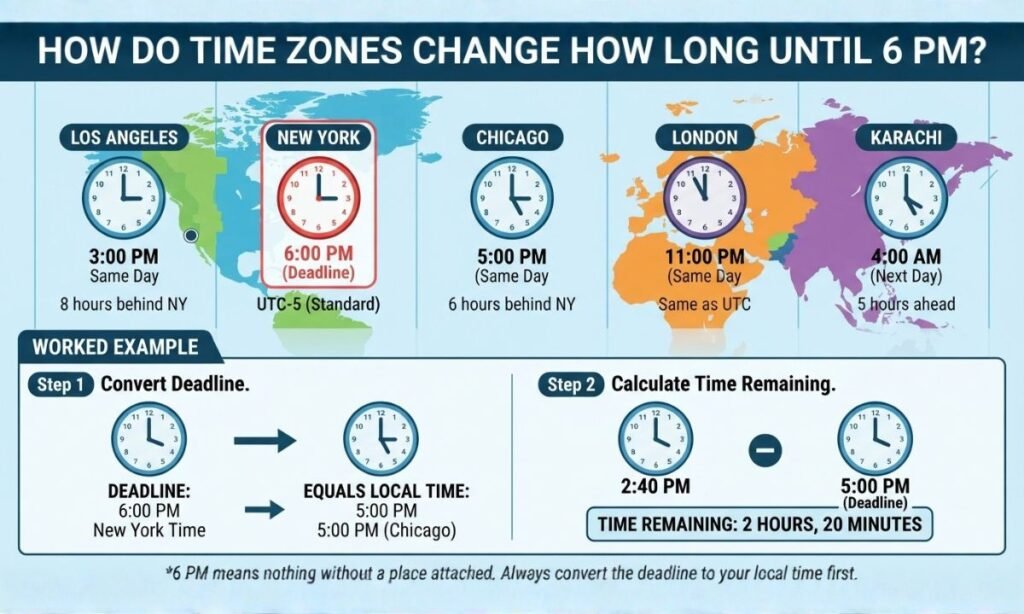
Convert the 6 PM deadline into your local time first, then subtract. The phrase “6 PM” means nothing without a place attached. Six PM in New York is a different moment than 6 PM in Karachi.
The table below shows what the clock reads elsewhere when it’s 6:00 PM in New York during standard time. New York is 5 hours behind UTC in that season.
| City | Difference from UTC | Local time when New York shows 6 PM |
| Los Angeles | 8 hours behind | 3:00 PM, same day |
| Chicago | 6 hours behind | 5:00 PM, same day |
| London (winter) | Same as UTC | 11:00 PM, same day |
| Paris | 1 hour ahead | 12:00 AM, next day |
| Dubai | 4 hours ahead | 3:00 AM, next day |
| Karachi | 5 hours ahead | 4:00 AM, next day |
| Delhi | 5 hours 30 minutes ahead | 4:30 AM, next day |
| Tokyo | 9 hours ahead | 8:00 AM, next day |
Here is a worked example. Your deadline says 6 PM New York time, and you’re in Chicago. That equals 5:00 PM where you sit. If your Chicago clock reads 2:40 PM, you have 2 hours and 20 minutes.
Watch out for labels like “ET” or “Eastern.” They cover both standard and daylight time. The label follows whatever rule is active in that region on that date.
How does daylight saving time affect the countdown?
Daylight saving time shifts a same day countdown by one hour on the two days clocks change. It can also change the gap between two cities for a few weeks. Neither effect is large, but both cause missed calls.
In 2026, the US ends daylight saving time on Sunday, November 1. At 2:00 AM the clocks go back to 1:00 AM. Most of Europe changes a week earlier, on Sunday, October 25.
That creates an odd week. Between October 25 and November 1, London is only 4 hours ahead of New York. The usual gap is 5 hours. Check meeting times carefully during that window.
The change day itself is tricky. On November 1 in the US, a countdown that starts at midnight runs 19 real hours to 6 PM, not 18. An extra hour occurs in the night. In spring the reverse happens, and the same countdown shrinks to 17 hours.
Not every place changes clocks. Japan, India, and China don’t use daylight saving time. Most of Arizona skips it too. Rules can change, so confirm local rules if a deadline matters.
Which tools tell you how long until 6 PM?
Your phone, a countdown page, or a spreadsheet can do it for you. Pick whichever fits the moment.
- Voice assistant. Ask “how long until 6 PM?” and it answers using your local clock.
- Timer. Work out the gap yourself, then set a timer for it.
- Alarm. Set one for 6:00 PM, or for 5:45 PM if you need travel time.
- Countdown page. Search for a countdown to 6 PM and leave the tab open.
- Spreadsheet formula. Handy if you track deadlines in a sheet.
For the spreadsheet route, type this into a cell and format it as time:
=MOD(TIME(18,0,0)-MOD(NOW(),1),1)
The formula subtracts the current time of day from 6 PM. The outer MOD wraps the answer so it still works after 6 PM. In that case it counts to tomorrow’s 6 PM.
Tools are fast. Still, learn one manual method. Phones die, and some meetings ban screens.
Why do people ask how long until 6 PM?
People ask because 6 PM is a common finish line. Many offices wrap up around 5 or 6 PM, though hours vary by job and country. Dinner plans, school pickups, and store closing times often cluster around it.
It also shows up in deadlines. A form due by 6 PM gives you a hard stop. Knowing the gap tells you whether to start now or grab lunch first.
Some people just want a mood boost. Watching the last hour of the workday shrink can make it feel shorter. That’s not science. It’s a habit plenty of people share.
How can you use the hours before 6 PM well?
Split the time left into blocks, then give each block a job. A big lump of hours feels endless. Small pieces feel doable.
Try this with 3 hours left. Work in cycles of 25 minutes of focus and 5 minutes of rest. Each cycle takes 30 minutes, so 3 hours gives you 6 cycles.
Save the last 20 minutes for wrap up. Write tomorrow’s top task on a sticky note. Send the one email you’ve been avoiding.
Set two alarms if you have somewhere to be. One goes off 30 minutes before 6 PM. The other goes off at 6:00. The first gives you room to leave. The second is your backup.
What mistakes should you avoid?
The biggest mistakes come from the clock labels, not the math. Here are the ones that show up most.
- Mixing AM and PM. A 6 AM answer and a 6 PM answer differ by 12 hours.
- Confusing noon and midnight. 12 PM is noon. 12 AM is midnight.
- Using decimals for minutes. 2:15 is not 2.15 hours. Fifteen minutes is 0.25 hours, so 2:15 equals 2.25 hours.
- Ignoring the time zone. A deadline in another city needs converting first.
- Forgetting daylight saving time. Check the calendar around the clock change dates.
- Forgetting that 6 PM may have passed. After 6:00 PM the answer points to tomorrow.
One habit prevents most of these. Say the answer out loud with the labels. “Three hours and forty five minutes until 6 PM tonight” catches errors that “3:45” hides.
Frequently asked questions
How many hours until 6 PM from noon?
There are exactly 6 hours from noon to 6 PM. Noon is 12:00 PM, and 6 PM is 18:00 on a 24 hour clock.
What is 6 PM in 24 hour time?
6 PM is 18:00. Add 12 to the PM hour to convert it.
How many minutes until 6 PM if it’s 5:15 PM?
You have 45 minutes left. Count 45 minutes from 5:15 to reach 6:00.
How long until 6 PM tomorrow?
Subtract the time since 6 PM today from 24 hours. If 6 PM hasn’t happened yet today, add 24 hours to today’s countdown.
Does daylight saving time change 6 PM?
The clock still reads 6 PM, but the hours before it change on clock change days. A countdown across that night runs one hour longer in fall and one hour shorter in spring.
What should you do next?
Pick one method and use it three times today. The borrow method suits people who like exact numbers. The count up method suits mental math. Whichever you choose, you’ll stop reaching for your phone every time you ask how long until 6 PM.
If a deadline sits in another time zone, convert it right now. Write the local time next to the original. Then set an alarm 30 minutes early and get back to work.