
Pokémon cards have a size that feels familiar the moment you pick one up. That is not an accident. Every card, from a 1999 Charizard to a card pulled from a pack last week, follows the same exact measurements.
Knowing these numbers matters if you are buying sleeves, printing custom art, checking centering for grading, or simply trying to figure out if a card in your hand is real.
This guide covers every measurement you need, in every unit, for every use case.
Pokémon Card Size at a Glance (Quick Summary)
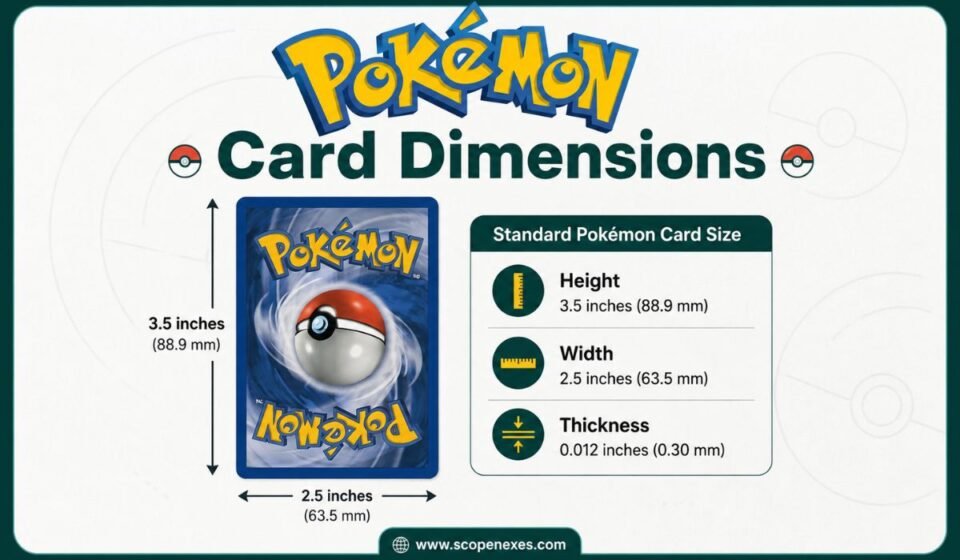
A standard Pokémon card measures 2.5 inches wide by 3.5 inches tall. In metric terms, that is 6.35 cm by 8.89 cm, or 63.5 mm by 88.9 mm. This is the same standard Pokémon card size used for every set since the game launched, so a sleeve made years ago still fits a card printed today.
Here is the full snapshot in one table:
| Measurement | Inches | Centimeters | Millimeters |
| Width | 2.5 in | 6.35 cm | 63.5 mm |
| Height | 3.5 in | 8.89 cm | 88.9 mm |
| Corner radius | 0.125 in | 0.3175 cm | 3.175 mm |
| Thickness | 0.012 in | 0.03 cm | 0.30 to 0.32 mm |
| Weight | Not applicable | Not applicable | 1.70 to 1.80 g |
These Pokémon card measurements apply across nearly every mainline product, whether the card came from a booster pack, a tin, or an elite trainer box. The one exception is oversized promo cards, which get their own section further down.
Exact Pokémon Card Measurements
Width and Height in Inches, CM, and MM
The width and height of a Pokémon card do not change from set to set. A card printed in the original Base Set uses the same physical footprint as a card printed this year. The Pokémon card dimensions in inches are 2.5 by 3.5. In centimeters, that becomes 6.35 by 8.89. In millimeters, it is 63.5 by 88.9.
Grading companies like PSA and BGS work almost entirely in millimeters because the smaller unit gives more precision. When a grader checks centering, they are looking at how evenly the border sits within that 63.5 mm by 88.9 mm frame. A shift of even half a millimeter can be enough to drop a grade from a perfect score to a near perfect one.
Manufacturing tolerance on genuine cards is tight, usually within plus or minus 0.2 to 0.3 mm. That tight window is part of why millions of cards printed across different years and countries all fit the same sleeve without any wobble.
Standard Pokémon Card Thickness
Pokémon card thickness sits between 0.30 mm and 0.32 mm for a standard card. Holographic and full art cards run slightly thicker, up to about 0.35 mm, because of the extra foil layer bonded onto the surface.
The card itself is built from three layers. Two outer layers of white cardstock sandwich a thin core, usually a darker material, that gives the card its stiffness and its resistance to light. This layered build is the reason a genuine card feels rigid rather than floppy, and it plays a direct role in the fake detection methods covered later in this guide.
Standard Pokémon Card Weight
A genuine standard Pokémon card weighs between 1.70 and 1.80 grams. This might sound like a tiny detail, but it is one of the more reliable checks available to a collector without any special tools beyond a cheap kitchen scale.
Weight can shift slightly depending on whether a card is holographic, since the foil layer adds a small amount of mass. Still, anything noticeably outside that 1.70 to 1.80 gram window on a supposedly standard card is worth a second look.
Standard Pokémon Card Dimensions in Pixels (Digital & Print)
Anyone making custom art, printing proxies for personal use, or building a digital display needs the Pokémon card dimensions in pixels, not just inches. Skipping this step is one of the most common mistakes people make when they try to print their own designs.
Pixel Size at 300 DPI, 600 DPI, and 720 DPI
DPI stands for dots per inch, and it controls how sharp an image looks once it is printed. The higher the DPI, the more pixel information is packed into the same physical space.
| DPI Level | Width (px) | Height (px) | Best Use |
| 72 DPI | 180 px | 252 px | Screen display only |
| 150 DPI | 375 px | 525 px | Rough drafts |
| 300 DPI | 750 px | 1050 px | Standard home or commercial printing |
| 600 DPI | 1500 px | 2100 px | High detail archival work |
| 720 DPI | 1800 px | 2520 px | Upscaled reprints and fine line art |
For anyone printing a Pokémon card at 300 DPI, 750 by 1050 pixels is the baseline you want. Going lower than that will look fine on a phone screen but blurry the moment it hits paper. The 720 DPI option is worth using only if you are scanning fine line work or preparing a file for a professional archival printer, since the file size grows fast and most home printers will not show a visible difference over 600 DPI.
Print Bleed and Safe Area Requirements
Printers rarely cut with perfect precision. To stop a thin white line from showing on the trimmed edge, artists add extra image area around the card called bleed. For Pokémon card print dimensions, the standard bleed is 0.125 inches on every side. That brings the full canvas up to 2.75 by 3.75 inches, or 825 by 1125 pixels at 300 DPI.
Inside that canvas sits a safe zone, roughly 2.25 by 3.25 inches, where all important text and artwork should stay. Anything placed outside the safe zone risks being trimmed off during the final cut.
Procreate Canvas Settings for Custom Pokémon Cards
Setting up a Pokémon card Procreate canvas correctly from the start saves a lot of frustration later. Use these settings:
- Canvas size: 2.75 by 3.75 inches to include bleed
- Resolution: 300 DPI for most projects, 600 DPI for fine detail work
- Color profile: CMYK if the file is headed to a printer, RGB if it stays digital
- Aspect ratio: 5 to 7
One thing worth knowing before you start is that pushing past 300 DPI at this canvas size will cut into the number of layers Procreate lets you use, since the app allocates memory based on total pixel count. If you need heavy layering for shading or line art, work at 300 DPI and only bump the resolution up at export time if a printer specifically requests it.
All Pokémon Card Sizes: Standard, Jumbo, and Variants
Standard Physical Cards
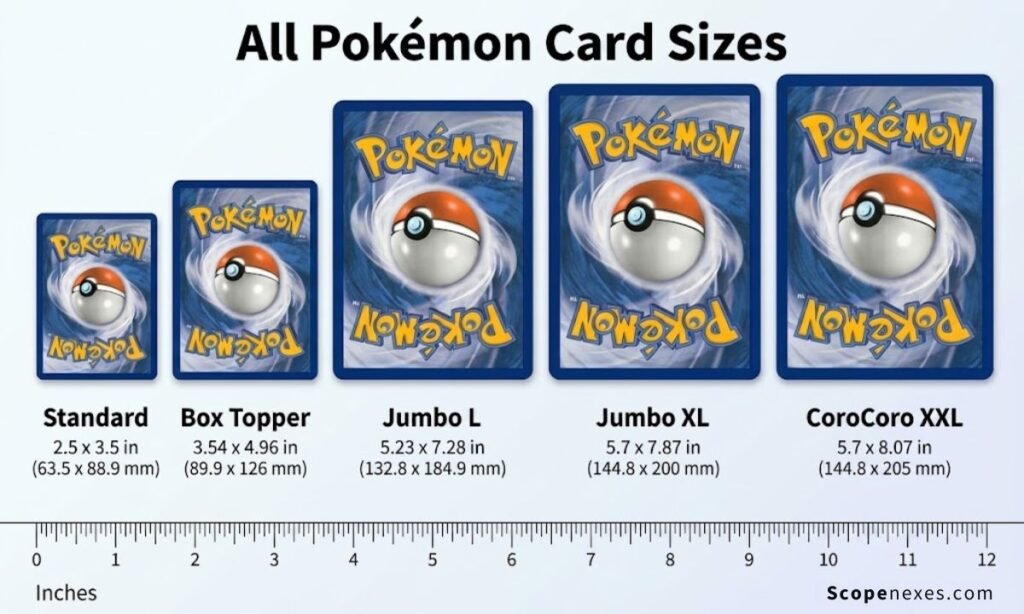
The standard Pokémon TCG card size, at 2.5 by 3.5 inches, covers the overwhelming majority of cards you will ever hold, from common energy cards to secret rare full art cards. Rarity does not change the physical size, only the printing and finish.
Jumbo Pokémon Cards
Jumbo cards are oversized promotional pieces, usually given away at events or included in special products. The size of these cards has actually changed over time, which trips up a lot of collectors buying storage for older pieces.
| Card Type | Width (in) | Height (in) | Width (mm) | Height (mm) |
| Jumbo (pre 2020) | 6.0 in | 8.0 in | 152.4 mm | 203.2 mm |
| Jumbo (post 2020) | 5.37 in | 7.37 in | 136.5 mm | 187.3 mm |
| Jumbo L | 5.23 in | 7.28 in | 133 mm | 185 mm |
| Jumbo XL (pre 2019) | 5.70 in | 7.87 in | 145 mm | 200 mm |
| CoroCoro XXL | 5.70 in | 8.07 in | 145 mm | 205 mm |
If you are shopping for oversized Pokémon card sleeves or a binder for jumbo pieces, always check which era your card is from first. A pre 2020 jumbo card will not sit properly in a sleeve sized for the newer, smaller jumbo format.
VSTAR, Oversized, and Box Topper Variants
VSTAR, VMAX, and other special mechanic cards are printed at the same standard size as every other card in a booster pack. The size changes only when a card is explicitly labeled as a jumbo or oversized promo, not simply because it has a rare mechanic or full art treatment.
Box toppers, the cards found sitting on top of a booster box, are printed larger than standard but smaller than jumbo, generally around 3.54 by 4.96 inches. These need their own storage sleeve since neither a standard nor a jumbo sleeve fits them well.
Visual Comparisons: How Big Is a Pokémon Card?
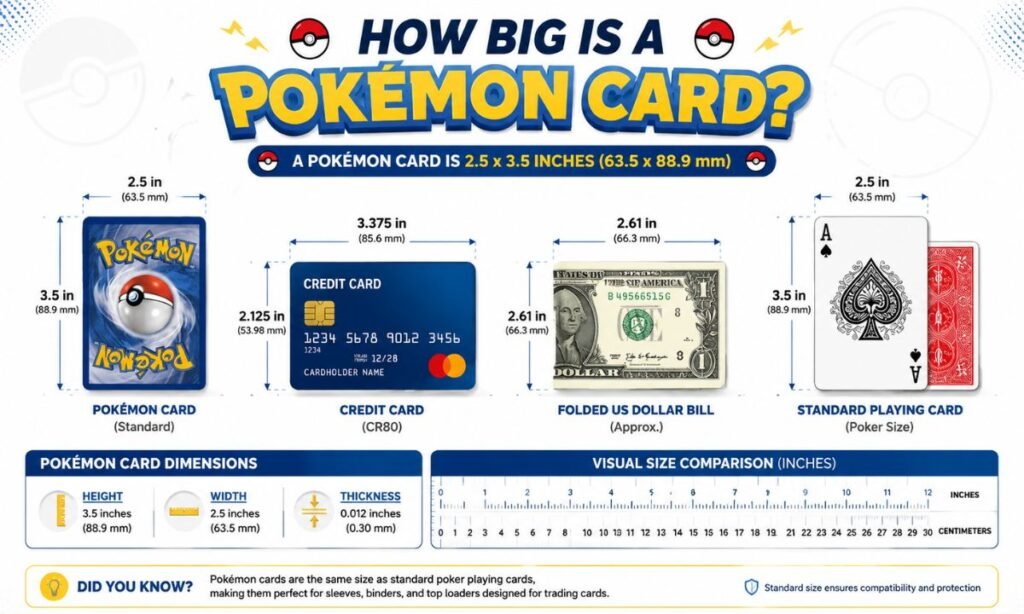
Numbers are useful, but a mental picture sticks better. Here is how a Pokémon card compares to things you probably already have nearby.
Credit Card
A credit card measures 3.37 by 2.125 inches. A Pokémon card, at 3.5 by 2.5 inches, is slightly larger in both directions. Set them side by side and the difference is small, about the width of a pencil eraser on the long edge.
Standard Playing Card (Poker Size)
This is the closest match available. A poker sized playing card is exactly 2.5 by 3.5 inches, identical to a Pokémon card. If you have ever shuffled a deck of playing cards, you already know exactly how a Pokémon card feels in hand.
US Dollar Bill
A dollar bill measures 6.14 by 2.61 inches. Fold it in half the short way and you get a rectangle close to 3.07 by 2.61 inches, just a bit shorter and wider than a Pokémon card. It is a handy trick if you need a rough size check away from home.
Post-It Note
A standard square Post-it note is 3 by 3 inches. A Pokémon card, at 2.5 by 3.5 inches, is narrower but taller, which helps show off the card’s tall portrait shape and its 5 to 7 aspect ratio.
Smartphone
Most phones run between 2.8 and 3.1 inches wide, wider than a Pokémon card’s 2.5 inch width, but shorter than its 3.5 inch height. This comparison explains why cards feel compact and easy to hold even during long play sessions.
Japanese vs International Pokémon Cards: Same Size
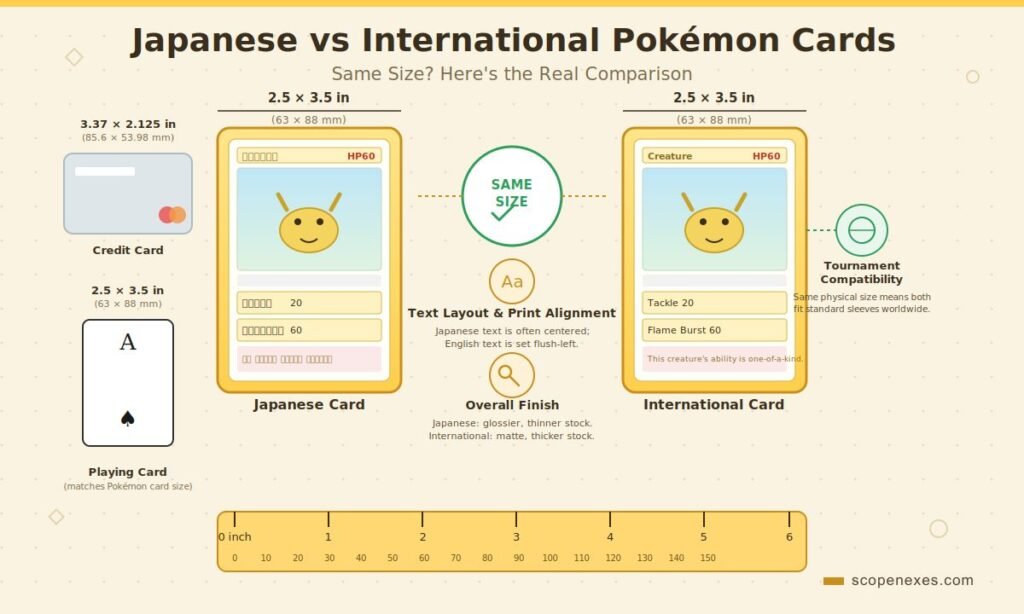
There is a long running myth that Japanese Pokémon cards are smaller than English or other international prints. This is not true. Japanese Pokémon TCG cards measure the exact same 63.5 by 88.9 mm as every other region.
The confusion comes from other Japanese card games. Yu-Gi-Oh! and Cardfight Vanguard both use a smaller 59 by 86 mm format, and people sometimes assume all Japanese cards share that size. Pokémon is the exception here, not the rule.
As one longtime collector put it in a community forum discussion on card sizing:
“I wasted money on small sleeves before I learned Pokémon doesn’t follow the same size as my Yu-Gi-Oh cards. Lesson learned the expensive way.”
Buying the wrong region sleeve size for a Pokémon card, specifically the 62 by 89 mm Japanese size meant for other games, will damage the card. It simply will not fit, and forcing it can warp the cardstock permanently.
Pokemon Card Dimensions for Sleeves and Storage
Sleeve Sizes by Type
Getting Pokémon card sleeve size right protects the investment you have already made in your collection.
| Sleeve Type | Internal Width | Internal Height | Best For |
| Standard outer sleeve | 66 to 67 mm | 91 to 92 mm | Everyday play and single sleeving |
| Perfect fit inner sleeve | 64 mm | 89 mm | Double sleeving, archival storage |
| Japanese size (avoid for Pokémon) | 62 mm | 89 mm | Yu-Gi-Oh and similar games only |
| Jumbo outer sleeve | 127 mm | 178 mm | Oversized and older jumbo cards |
Standard outer sleeves give the card a small buffer, usually about 1.5 mm per side, which stops the corners from catching on the seam during insertion. Perfect fit sleeves sit tight against the card and work best as the inner layer when double sleeving, paired with a standard outer sleeve on top for a snug, dust resistant setup.
Toploader Sizes
Toploaders are rigid holders used for extra protection, especially during shipping or long term storage.
- 35 PT toploaders fit a single sleeved standard card
- 55 PT toploaders fit a double sleeved card
- 75 PT and higher toploaders are not needed for standard Pokémon cards
The PT number refers to the internal capacity of the toploader, not the thickness of the card itself. A standard card on its own is roughly 12 to 14 PT thick.
Pokemon Card vs Other Trading Cards
| Card Game | Width (in) | Height (in) | Same Sleeves as Pokémon |
| Pokémon TCG | 2.5 in | 3.5 in | Yes |
| Magic: The Gathering | 2.5 in | 3.5 in | Yes |
| Yu-Gi-Oh! | 2.35 in | 3.38 in | No |
| Standard playing cards | 2.5 in | 3.5 in | Yes |
| Baseball cards | 2.5 in | 3.5 in | Yes |
| Bridge playing cards | 2.25 in | 3.5 in | No |
Pokémon and Magic: The Gathering share the exact same footprint, so sleeves, binders, and toploaders are fully interchangeable between the two. Yu-Gi-Oh! runs noticeably smaller and needs its own dedicated accessories.
How to Spot Fake Pokémon Cards Using Dimensions
Width and Height
Genuine cards measure 63.5 by 88.9 mm within a tight tolerance. Counterfeits often come in at 62 mm or 65 mm wide, a difference that becomes obvious the moment the fake sits next to a real card in a deck.
Thickness
A real card runs 0.30 to 0.32 mm thick. Fakes tend to go one of two ways, either too thin because they skip the graphite core, or too thick and waxy because they use cheap laminated plastic instead of proper cardstock.
Weight
Genuine cards weigh 1.70 to 1.80 grams. Fakes usually land outside that range, either lighter around 1.50 to 1.62 grams from a missing core layer, or heavier at 1.95 grams and up from dense plastic filler.
The Light Test
Hold the card up to a bright light. A genuine card has a dark core layer that blocks most light from passing through. If light shines through easily, the core is missing and the card is almost certainly fake.
Corner Radius
Real cards have a smooth, even 0.125 inch corner radius. Fakes often show jagged or uneven corners from lower quality cutting equipment, something you can usually spot with the naked eye under good lighting.
How to Measure a Pokémon Card Accurately at Home
You do not need a lab to get a solid read on a card’s size. A credit card, at 2.125 inches wide, is about 3 eighths of an inch narrower than a Pokémon card, so holding them together gives a rough visual check. A folded dollar bill, at roughly 3.07 inches tall when folded in half the short way, lands just under a Pokémon card’s 3.5 inch height.
For a more precise check, a cheap digital caliper measures width, height, and thickness in seconds, and a basic kitchen scale accurate to a tenth of a gram will confirm weight against the 1.70 to 1.80 gram range. Most phone ruler apps also work in a pinch, though they are less reliable than a physical tool for catching a fake.
FAQs
What are the exact dimensions of a Pokémon card?
A standard Pokémon card measures 2.5 by 3.5 inches, or 63.5 by 88.9 millimeters, exactly every single time.
How much does a Pokémon card weigh?
A genuine standard Pokémon card weighs between 1.70 and 1.80 grams, is easily checked with a kitchen scale.
What size sleeves fit Pokémon cards?
Standard outer sleeves run 66 to 67 mm wide and 91 to 92 mm tall for proper fit.
Are Japanese Pokémon cards smaller than international cards?
No, Japanese Pokémon cards measure the same 63.5 by 88.9 millimeters as international English language cards used worldwide.
How can you tell if a Pokémon card is fake?
Check width, height, thickness, and weight against genuine ranges, then shine light through the card to verify authenticity.
Summary
A standard Pokémon card measures 2.5 by 3.5 inches, or 63.5 by 88.9 mm, weighs between 1.70 and 1.80 grams, and runs 0.30 to 0.32 mm thick.
Those four numbers cover nearly every practical need, from choosing the right sleeve to spotting a counterfeit before it costs you money. Digital creators should work at 750 by 1050 pixels at 300 DPI, adding bleed for print.
Keep this guide handy, because these measurements have not changed since 1996 and are not likely to change anytime soon.